

Employee satisfaction and customer satisfaction are often discussed as separate outcomes, managed through different programs, metrics, or initiatives. One is handled by HR, the other by customer experience teams. Yet in practice, both tend to rise or fall together, shaped by the same underlying structures.
A common source of strain appears when employees spend a large portion of their time on work that feels misaligned with their skills or judgment. Routine, repetitive, or administratively dense tasks absorb attention that could otherwise be used for problem-solving, learning, or meaningful interaction. Over time, this mismatch erodes engagement—not through burnout alone, but through a quiet sense of underutilization.
Outsourcing changes this pattern by altering what remains inside the role boundary.
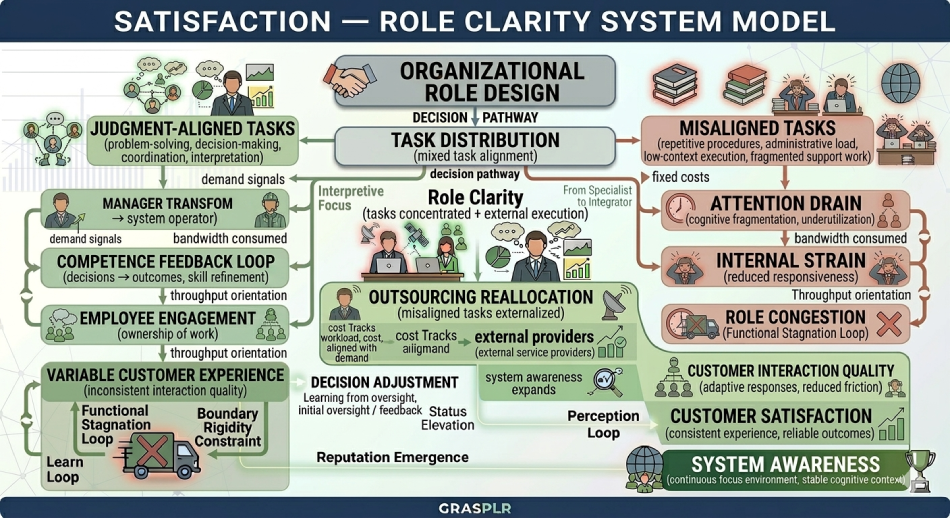
Satisfaction and Task Fit
From a systems perspective, satisfaction is strongly influenced by task fit: the degree to which daily work aligns with an individual’s capabilities and decision authority.
When employees are able to outsource tasks that are procedural or time-consuming, their role shifts. The remaining work tends to involve interpretation, prioritization, and coordination—activities where personal judgment matters. This does not eliminate effort, but it changes its character.
Outsourcing contributes by clarifying what work truly belongs inside the organization and what can be handled elsewhere with minimal loss of coherence. When this distinction is well made, internal roles become more meaningful and external interactions become more reliable.
The result is not a culture shift or a motivational surge, but a quieter form of alignment that customers and employees both experience as quality.
