

Companies often talk about “brand representation” as something shaped by messaging, guidelines, or training. But how an organization is actually represented—to customers, partners, and the public—is more directly influenced by how work is structured internally.
A useful analogy is a team-based environment where performance depends on coordination rather than individual effort alone. Each role exists for a reason, and overall success depends less on everyone doing everything, and more on each role being performed well. When roles are blurred or overloaded, performance degrades even if commitment remains high.
The same pattern appears in organizations.
When employees are responsible for too many peripheral or administrative tasks, their ability to perform their core role weakens. Attention is split. Quality becomes uneven. The outward-facing expression of the company—its service, communication, and decision-making—reflects this internal diffusion.
Outsourcing reshapes this dynamic by tightening role boundaries.
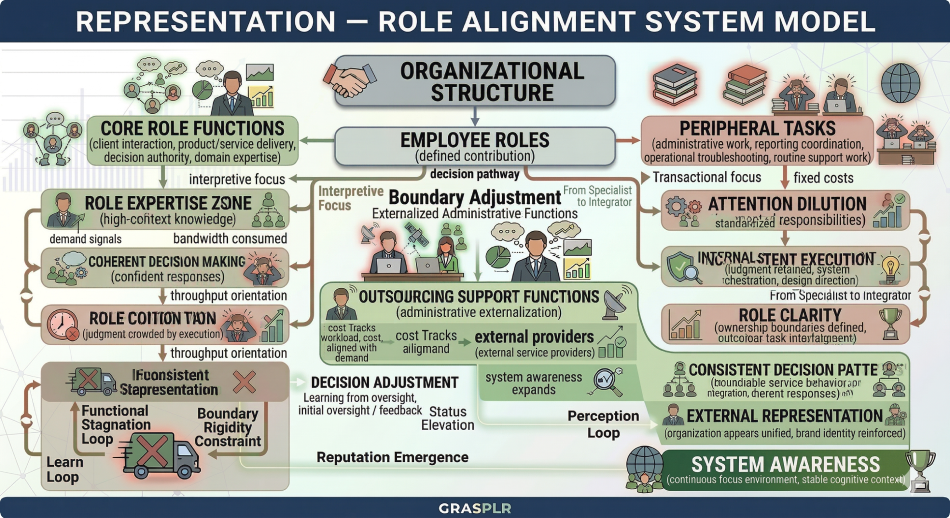
Role Clarity and External Perception
Representation is not only about what employees say or produce, but about how consistently and coherently they act. Customers infer the character of a company from repeated interactions: how reliably issues are handled, how confidently decisions are made, and how clearly responsibilities are owned.

Outsourcing contributes by removing noise from key roles. Employees are not made more representative through training or exhortation, but through structural conditions that allow them to perform their primary function well.
The sports team metaphor holds if treated carefully: performance improves when each role is supported by the right surrounding structure. Representation improves for the same reason.
