

Most systems claim to value many things.
An organization may say it values innovation, quality, customer satisfaction, efficiency, safety, and growth – all at the same time. On paper, these priorities appear equally important.
But real decisions rarely allow everything to be protected simultaneously.
When trade-offs appear – when time is limited, risks increase, or resources are constrained – the system must choose which priorities to protect and which to compromise.
These moments reveal something deeper than strategy.
They reveal the system’s value hierarchy.
Systems Layer
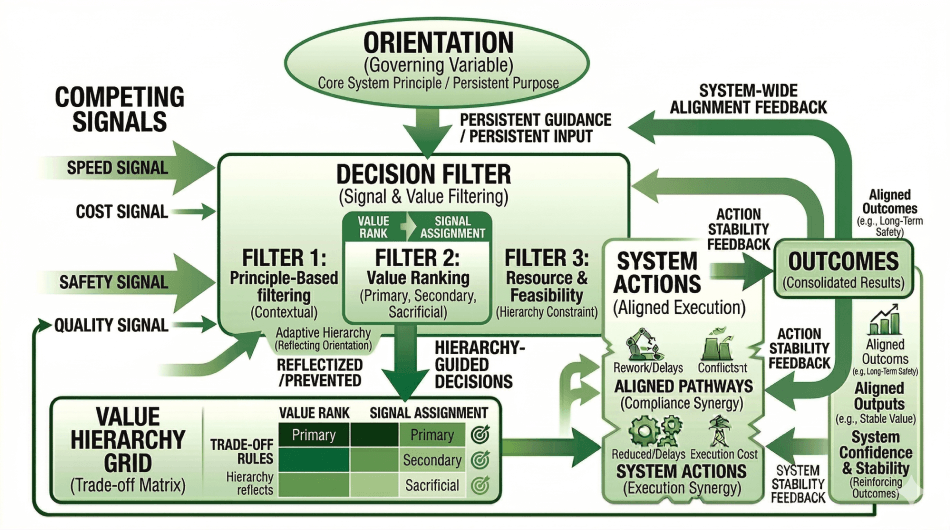
In Systems Language, orientation establishes the value hierarchy that determines how a system resolves trade-offs.
A value hierarchy is the ordered structure that ranks which signals, outcomes, and priorities the system will protect first when constraints require a decision.

The priority that survives the trade-off reveals the system’s true orientation.
Within the five-pillar framework, Orientation determines the value hierarchy that guides which outcomes the system protects and which it is willing to sacrifice.
