
Some systems remain steady even when their environment changes.
Markets shift. Technologies evolve. New competitors appear. Internal structures grow more complex. Yet despite these changes, certain organizations continue operating with surprising consistency.
Their decisions still follow the same logic. Their behavior still reflects the same priorities. Even when strategies adapt, the system’s overall direction feels stable.
Other systems respond very differently.
Every new pressure triggers a shift in priorities. Strategies change frequently. Teams become uncertain about what matters most.
The difference often lies in whether the system protects its central variable.
Systems Layer
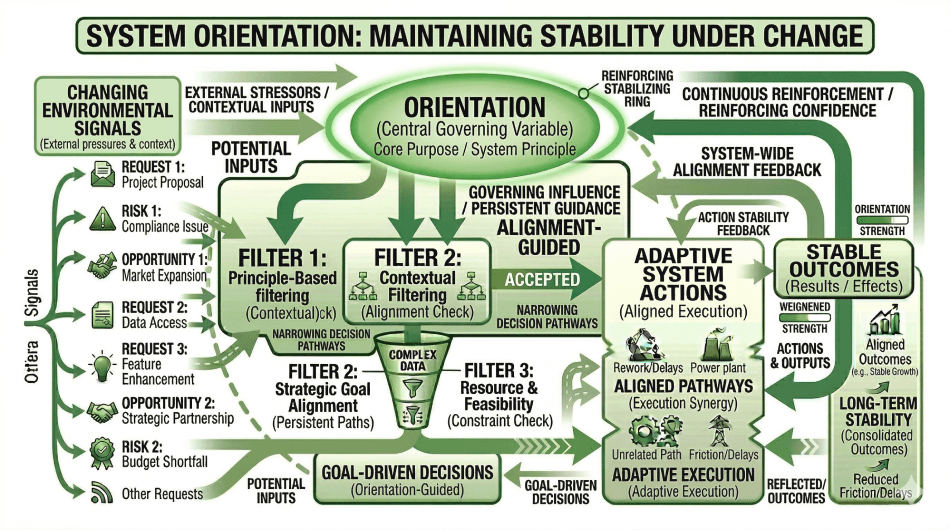
In Systems Language, stability emerges when a system protects its governing variable while allowing surrounding structures to adapt.
Orientation defines the governing variable – the priority condition the system attempts to maintain when processing signals and resolving trade-offs.

It comes from protecting the governing variable that organizes change.
Within the five-pillar framework, Orientation functions as the stabilizing center that allows systems to adapt their structure and behavior without losing their direction.