
Sometimes a system slowly loses its direction.
At first the change is subtle. Teams interpret priorities differently. Projects expand beyond their original purpose. Decisions begin to feel inconsistent across departments.
Over time the symptoms become more visible. Strategy debates increase. Coordination requires more effort. People spend more time negotiating priorities than executing work.
At that point, leaders often try to fix the problem through restructuring, new processes, or stronger oversight.
But when alignment has been lost, the real challenge is usually simpler.
The system needs to recover its direction.
Systems Layer
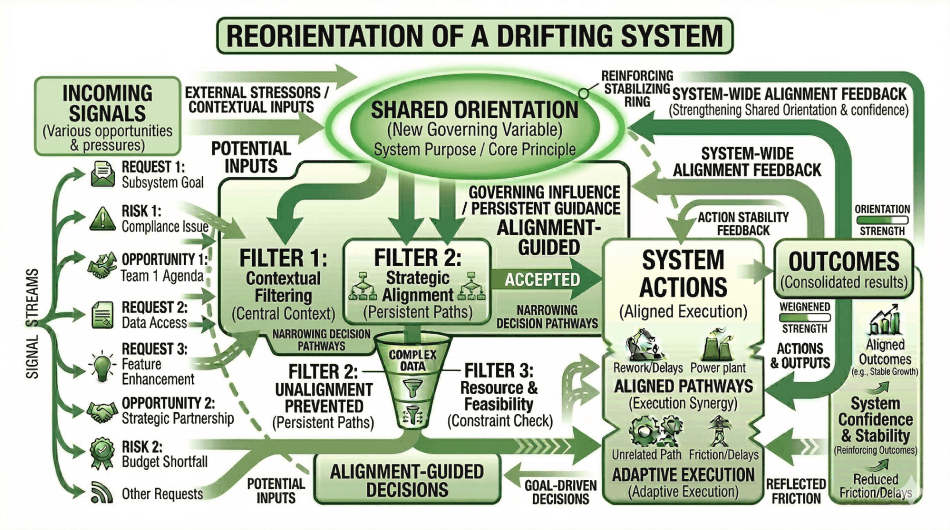
In Systems Language, reorienting a drifting system involves restoring a stable governing variable that can again function as the system’s primary reference condition.
Drift occurs when the original orientation weakens and multiple subsystems stabilize around local governing variables. Decision filters across the system begin prioritizing different signals.

They realign when a clear center is restored and embedded into decision-making.
Within the five-pillar framework, Orientation provides the structural anchor that allows leaders to re-stabilize systems that have gradually lost their direction.