
A team launches a project with strong momentum. Communication channels are active, dashboards update in real time, and information flows constantly across email, chat, documents, and meetings.
At first, this level of visibility seems helpful. Everyone has access to everything.
But over time, decisions begin to slow down. Important messages get buried in long threads. People spend more time reviewing information than acting on it.
The system is full of data, yet clarity becomes harder to find.
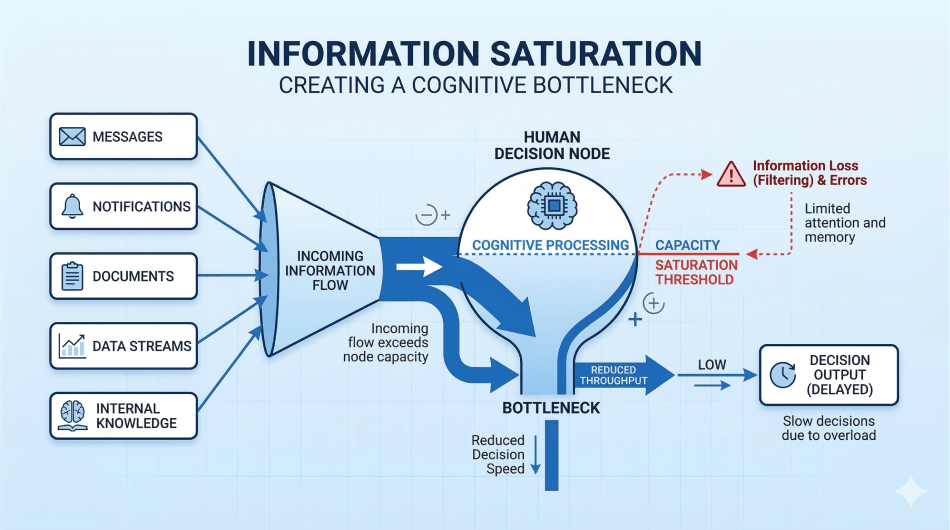
What looks like a communication problem is often something deeper — a cognitive bottleneck.
Systems Layer
A cognitive bottleneck occurs when the flow of information entering a system exceeds the rate at which that system can process and interpret signals.
In modern knowledge environments, information production scales easily. Messages, documents, notifications, and updates can be generated continuously with minimal cost.

Within the Cognitive Load pillar, effective systems reduce bottlenecks by managing the flow of information into decision nodes, ensuring that processing capacity is reserved for interpreting meaningful signals rather than filtering noise.
Clarity emerges when systems control information flow, not when they maximize it.