

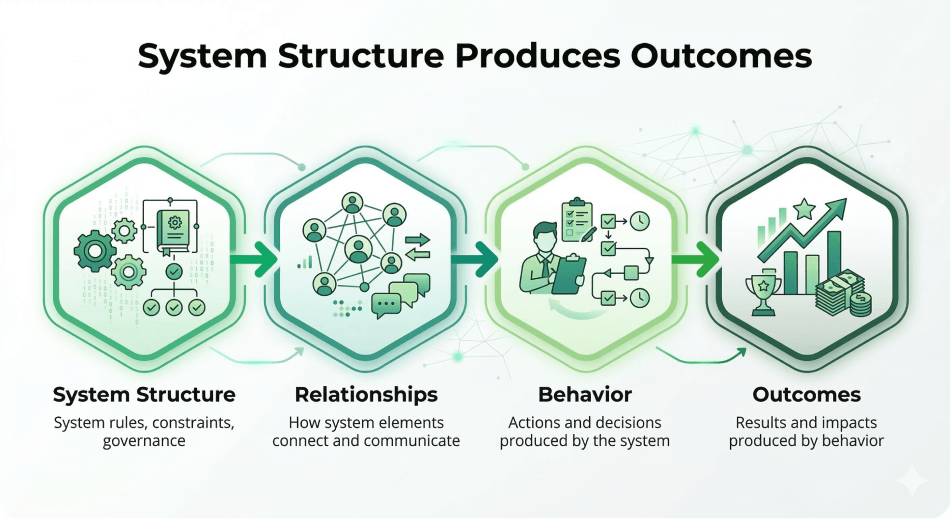
The Linear Causal Structure Model illustrates one of the most fundamental principles of systems thinking: outcomes are produced by structure.
Many people try to explain results by focusing on individual decisions, effort, or short-term events. Systems thinking approaches the problem differently. Instead of starting with outcomes, it begins with the underlying structure that shapes how a system operates.
The diagram shows a simple causal chain moving from structure to results. Each stage builds on the previous one, forming a predictable pathway through which system behavior emerges.
System Structure
The first element in the diagram is the system structure. Structure represents the design of the system itself.

This includes the rules that guide behavior, the constraints that limit what can occur, and the governance that defines authority and responsibility. Structure also determines what processes exist, how work flows, and what standards must be followed.
In organizations, structure may include policies, reporting lines, workflow rules, and operational procedures. In technical systems it may include architecture, protocols, and control logic.
Structure does not directly produce results. Instead, it establishes the conditions under which all activity takes place.
Relationships
Once the structure is established, it determines how the elements of the system connect and interact.
Relationships define how people, teams, or system components communicate with each other. They shape information flow, coordination patterns, and decision pathways.
For example, a system may require that information passes through several approval layers before action occurs. Another system might allow direct communication between participants.
These relationship patterns strongly influence how efficiently a system operates. Even when individuals are capable and motivated, poor structural relationships can produce confusion, delays, or misalignment.
Behavior
Behavior emerges from the interaction between structure and relationships.
At this stage, the system produces observable activity: decisions are made, work is performed, processes are executed, and resources are allocated.
Importantly, behavior is not random. It is shaped by the structural rules and communication patterns established earlier in the chain.
For example, if a system rewards speed over accuracy, people will naturally optimize for speed. If communication channels are fragmented, coordination behavior will also become fragmented.
Behavior therefore reflects how the system actually functions under its structural conditions.
Outcomes
Outcomes are the visible results generated by system behavior.
These results may include performance metrics, productivity levels, financial results, product quality, customer satisfaction, or system reliability.
Because outcomes are the final stage of the causal chain, they are often the most visible part of the system. However, they are also the most misleading place to diagnose problems.
Attempting to improve outcomes directly often fails because outcomes are symptoms of deeper structural causes.
Structural Translation
The model demonstrates that results are not produced by isolated actions. They emerge from the architecture of the system itself.
When a system consistently produces poor outcomes, the underlying cause is rarely a single mistake or individual failure. Instead, the system structure is usually creating conditions that make those outcomes likely.
Changing behavior without changing structure typically produces temporary improvement at best. Over time, the system returns to its structural pattern.
Lasting improvement requires modifying the structural conditions that shape behavior.
Structural Implication
When systems are well structured, relationships are clear, behaviors align with goals, and outcomes become predictable.
When structures are unclear or misaligned, even capable participants struggle to produce consistent results. Coordination becomes difficult, decisions slow down, and outcomes become unstable.
In these situations, organizations often attempt to fix problems through increased supervision, additional rules, or individual accountability. While these responses may appear helpful, they rarely address the structural source of the problem.
Leverage Insight
The most powerful point of intervention in a system is its structure.
Adjusting rules, constraints, roles, and communication pathways can transform how the entire system behaves. Once the structure changes, relationships adjust, behavior shifts, and outcomes follow.
This is why systems thinkers focus on structural design rather than isolated performance issues.
When the structure is correct, the system naturally produces the outcomes it was designed to generate.

