

Call us toll free: +64 226953063

Instant worldwide digital delivery — no waiting

GRASPLR Help & Support

Structural Archetype 8: System Evolution and Learning Model

This diagram represents how systems improve over time through cycles of behavior, feedback, learning, and structural redesign. A system does not remain static. It evolves by observing its own outcomes and adjusting either its operations or its structure.

At the center of the model is system behavior. This is how the system currently operates in the real world. It includes the processes, interactions, and decisions that produce results.
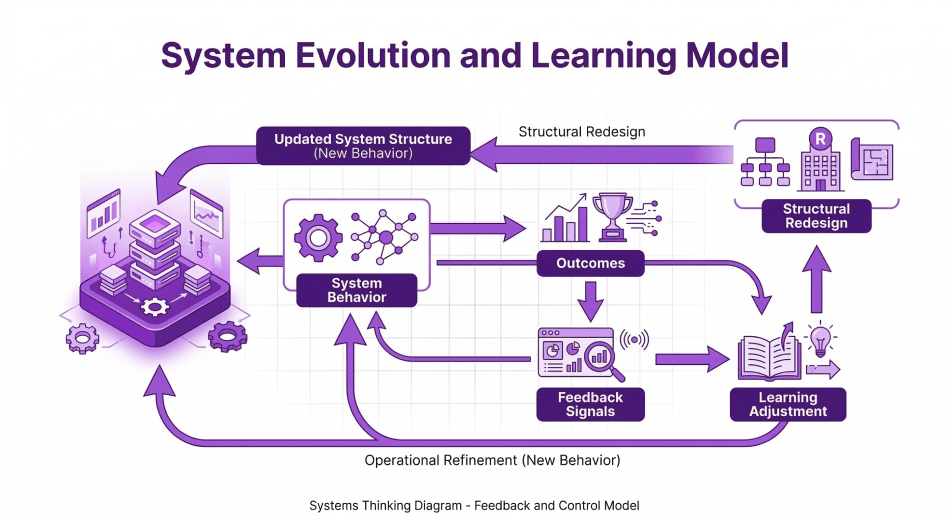
From this behavior emerge outcomes. Outcomes are the measurable effects produced by the system. They may include performance metrics, outputs, efficiency levels, growth indicators, or unintended consequences.

These outcomes generate feedback signals. Feedback signals are the information the system receives about its own performance. In practice, these may appear as data, observations, monitoring reports, customer reactions, or performance dashboards.

Once feedback signals are observed, the system enters the learning adjustment phase. This is where interpretation occurs. The system analyzes the feedback and attempts to understand what produced the observed outcomes.

Learning adjustment can lead to two different types of response.

The first response is operational refinement. Operational refinement means the system adjusts how it behaves without changing its underlying structure. Processes may be optimized, tasks reorganized, timing improved, or decisions refined. The structure remains largely the same, but behavior becomes more efficient.

The second response is structural redesign. When feedback reveals deeper problems or opportunities, the system may change its architecture. Structural redesign modifies the underlying configuration of the system. Roles may change, processes may be rebuilt, technologies replaced, or decision pathways redesigned.

When structural redesign occurs, the system produces an updated system structure. This new structure generates new patterns of system behavior, which in turn produce new outcomes.

The cycle then continues. Outcomes generate feedback signals, feedback produces learning, and learning produces either refinement or redesign.

The important insight shown in the diagram is that systems evolve through feedback-driven learning loops. The quality of the feedback determines the quality of the learning, and the quality of the learning determines whether the system improves or stagnates.

Systems that ignore feedback tend to repeat the same behaviors indefinitely. Systems that misinterpret feedback often refine the wrong processes. But systems that correctly interpret feedback can redesign themselves and move toward more effective structures.

This model therefore describes the mechanism through which systems adapt over time. It shows that improvement is not simply a matter of effort or intention. It is the result of structured feedback, accurate learning, and deliberate redesign.

In practice, the most resilient organizations, technologies, and social systems are those that maintain strong feedback channels and treat learning as a continuous structural process.

Over time, these systems accumulate improvements and evolve into more capable forms.

Here are the core term definitions that belong with this model.

System Behavior

System behavior is the observable way a system operates over time. It includes the actions, interactions, and processes that occur within the system as it responds to its environment. Behavior is not the structure itself, but the visible expression of that structure in motion.

Outcomes

Outcomes are the measurable results produced by system behavior. They represent what the system actually delivers to the environment, such as performance levels, outputs, efficiency, growth, stability, or unintended side effects.

Feedback Signals

Feedback signals are the information returned to the system about its own outcomes. These signals allow the system to evaluate whether its behavior is producing the desired results. Feedback may come through metrics, observations, monitoring tools, customer reactions, or environmental responses.

Learning Adjustment

Learning adjustment is the interpretive step where the system analyzes feedback signals and determines whether changes are needed. This stage represents the cognitive or analytical layer of the system where feedback becomes understanding.

Operational Refinement

Operational refinement occurs when the system adjusts its processes without changing its underlying structure. The system performs the same functions but improves how they are executed. Examples include process optimization, better coordination, or improved timing.

Structural Redesign

Structural redesign occurs when the system changes its architecture rather than just its operations. This may involve redesigning roles, processes, technologies, decision pathways, or relationships between components.

Updated System Structure

Updated system structure represents the new configuration that emerges after redesign. This structure creates new patterns of behavior, which then generate new outcomes.

System Evolution

System evolution is the long-term process through which repeated cycles of feedback, learning, refinement, and redesign gradually transform the system into a more capable form.

Now here is the interesting systems insight hiding inside this diagram.

Two different improvement loops exist inside it.

The short loop
Behavior → Outcomes → Feedback → Operational Refinement → Behavior

This is the optimization loop.

The long loop
Behavior → Outcomes → Feedback → Learning → Structural Redesign → New Structure → New Behavior

This is the evolution loop.

Many organizations only operate the short loop. They keep optimizing existing processes.

Systems that evolve activate the long loop. They redesign structure when feedback reveals deeper issues.

That distinction is one of the quiet dividing lines between systems that merely improve and systems that actually evolve.

Instant Digital Access

Secure download link delivered immediately after purchase

Built for Creators

Systems designed to help you build, not just download.

Global Compatibility

Files and toolkits accessible worldwide, no restrictions