
Leadership is often portrayed as directing people, making decisions, and setting priorities. But in complex organizations, those activities are only surface-level expressions of a deeper responsibility: shaping the system itself. Systems Leadership recognizes that outcomes emerge not from isolated actions but from interconnected relationships, feedback loops, incentives, and behaviors. Rather than managing individual parts, systems leaders create the conditions that allow the entire ecosystem to move in a coordinated direction.
Great Teams Still Struggle Inside Broken Systems
Many leadership challenges are misdiagnosed as people problems. Missed deadlines, inconsistent execution, communication breakdowns, and declining engagement are often attributed to individual performance. Yet high-performing people placed inside poorly aligned systems frequently produce disappointing results. Conflicting incentives, unclear information flows, and fragmented decision-making create friction that no amount of motivation can overcome. When leaders focus exclusively on individuals, they end up treating symptoms while the underlying architecture remains unchanged.
Systems Leadership as Ecosystem Design
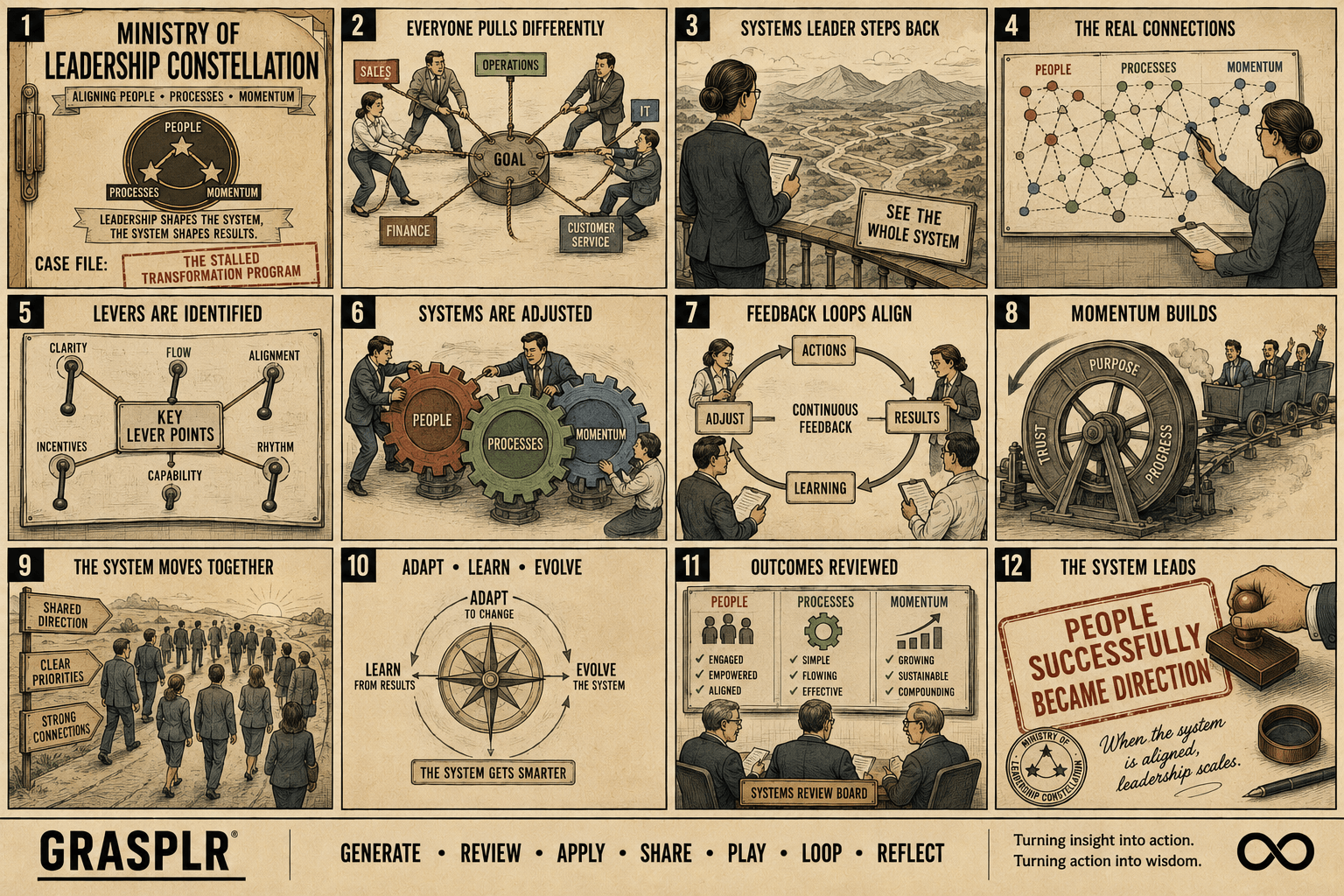
Systems Leadership is the practice of influencing outcomes by shaping the structures that produce them. Instead of asking, “How do I get people to work harder?” systems leaders ask, “What conditions make success easier to achieve?” They view organizations as living networks rather than mechanical hierarchies. Every process, communication channel, meeting rhythm, and decision pathway contributes to the overall behavior of the system. Leadership becomes less about control and more about alignment—ensuring that people, processes, and goals reinforce one another rather than compete for attention.
Building Alignment Across the Entire System
Effective systems leadership begins with visibility. Leaders must understand how information, responsibility, and influence move throughout the organization. Focus on three areas:
- Connection Points: Identify where teams, departments, and functions intersect. These handoffs often determine whether momentum accelerates or stalls.
- Feedback Loops: Create mechanisms that surface signals quickly. Strong systems learn and adapt because information circulates faster than problems grow.
- Shared Direction: Align incentives, priorities, and decision criteria around common objectives so individual success contributes to collective success.
Like an architect designing structural supports before adding decorative elements, systems leaders strengthen the relationships that hold the organization together before optimizing individual components.
Strong Systems Create Sustainable Leadership
The ultimate goal of systems leadership is not to become indispensable—it is to create an environment where progress continues without constant intervention. When alignment replaces friction and feedback replaces guesswork, organizations become more resilient, adaptable, and capable of sustained growth. Systems leaders understand that lasting influence comes from designing conditions that produce success repeatedly. Instead of driving every outcome themselves, they build ecosystems where momentum becomes self-reinforcing and leadership scales through the system itself.