Memory Cadence – How Strategic Timing Turns Ideas Into Lasting Knowledge

Repetition Loses Power When It’s Constant
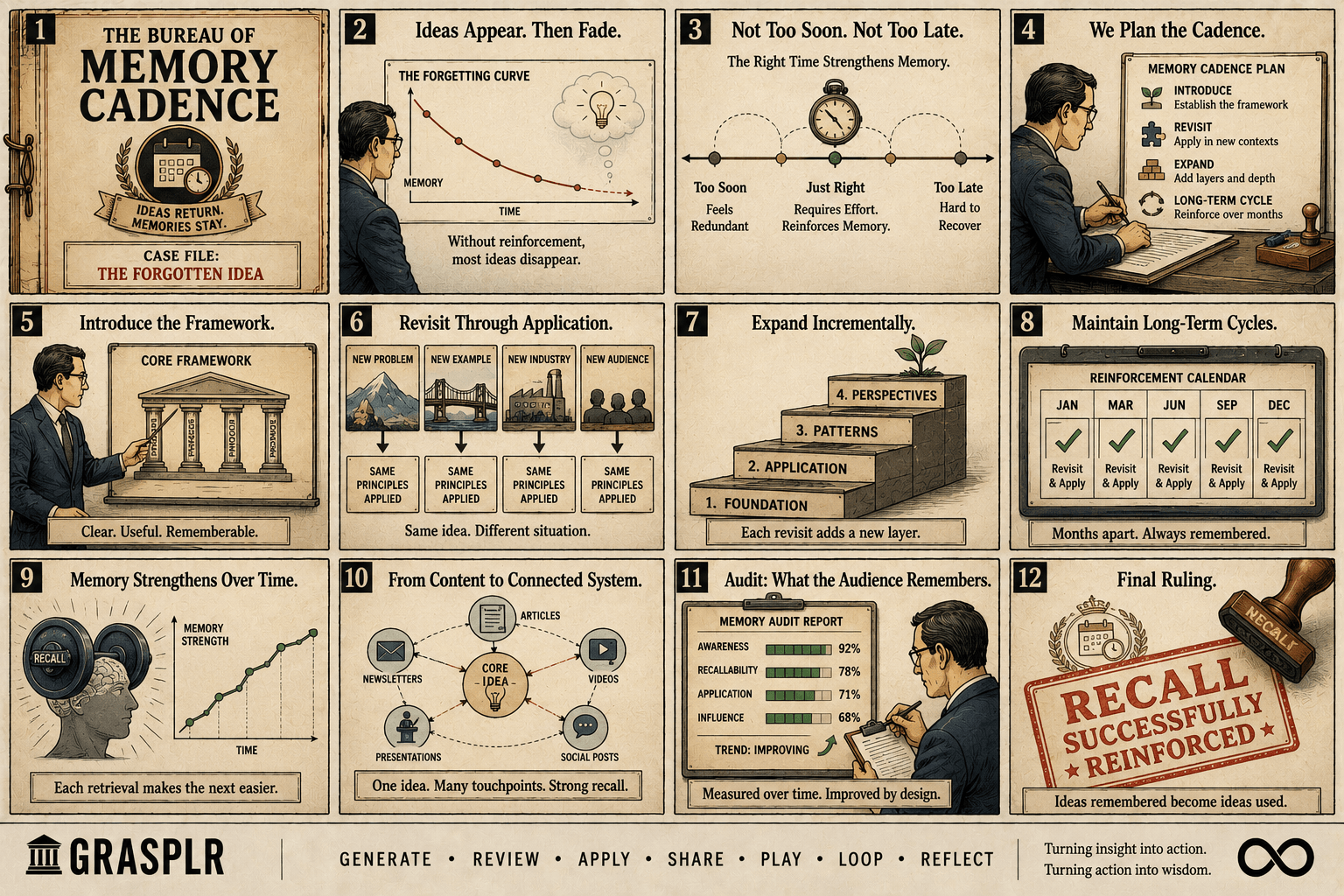
Many brands either repeat themselves too often or never revisit important concepts at all. Constant repetition feels redundant, while one-time publication leaves valuable ideas vulnerable to the natural curve of forgetting. Audiences don’t need endless reminders—they need timely reinforcement. The greatest influence comes from returning to an idea just as it begins to fade, renewing understanding before it disappears completely.
Memory Cadence and Strategic Reinforcement
Memory Cadence is the deliberate scheduling of core concepts across your content ecosystem so each reappearance strengthens previous learning. Rather than duplicating messages, each repetition expands, reframes, or applies an existing framework in a fresh context. The spacing between appearances allows memory to weaken just enough that retrieval requires effort, making each encounter more valuable than the last. Over time, isolated pieces of content become an interconnected system of durable knowledge.
Designing a Reinforcement Rhythm
Map your foundational ideas and plan when they should naturally re-emerge.
- Introduce the Framework: Establish the core concept with clarity and depth.
- Revisit Through Application: Show the same principle solving different problems across future content.
- Expand Incrementally: Add new layers, examples, or perspectives with each appearance.
- Maintain Long-Term Cycles: Continue resurfacing cornerstone ideas over months rather than days, allowing familiarity to compound without becoming repetitive.
Like planting a tree, growth doesn’t come from constant watering in a single day—it comes from consistent care delivered at the right intervals.
Ideas Remembered Become Systems That Endure
The strongest content ecosystems aren’t built on endless novelty—they’re built on strategic reinforcement. Memory Cadence transforms publishing from a stream of disconnected posts into a learning system where every revisit deepens understanding and strengthens recall. When you respect the timing of memory instead of simply increasing frequency, your ideas stop competing for attention and start becoming part of how your audience thinks.