

Most systems are designed to produce results. Few are designed to examine how those results are produced.
That gap matters. A system may keep delivering output while losing sight of the assumptions, habits, and decisions shaping that output.
Cognitive Mirrors bring metacognition into system design. Metacognition means thinking about thinking: the ability to observe, evaluate, and adjust how decisions are made. In systems, it means building mechanisms that help individuals, teams, and organizations examine how they operate, not only what they achieve.
When a system can see itself clearly, improvement becomes continuous rather than accidental.
Performance Without Reflection Eventually Plateaus
Many people assume repetition naturally creates mastery. More often, repetition creates reinforcement.
Teams repeat familiar processes. Organizations repeat familiar decisions. Content creators repeat familiar formats.
Over time, efficiency may increase, but awareness can decline.
Without reflection, systems become trapped by their own success. They keep producing outcomes while losing visibility into the patterns driving those outcomes. Stagnation begins to look like consistency.
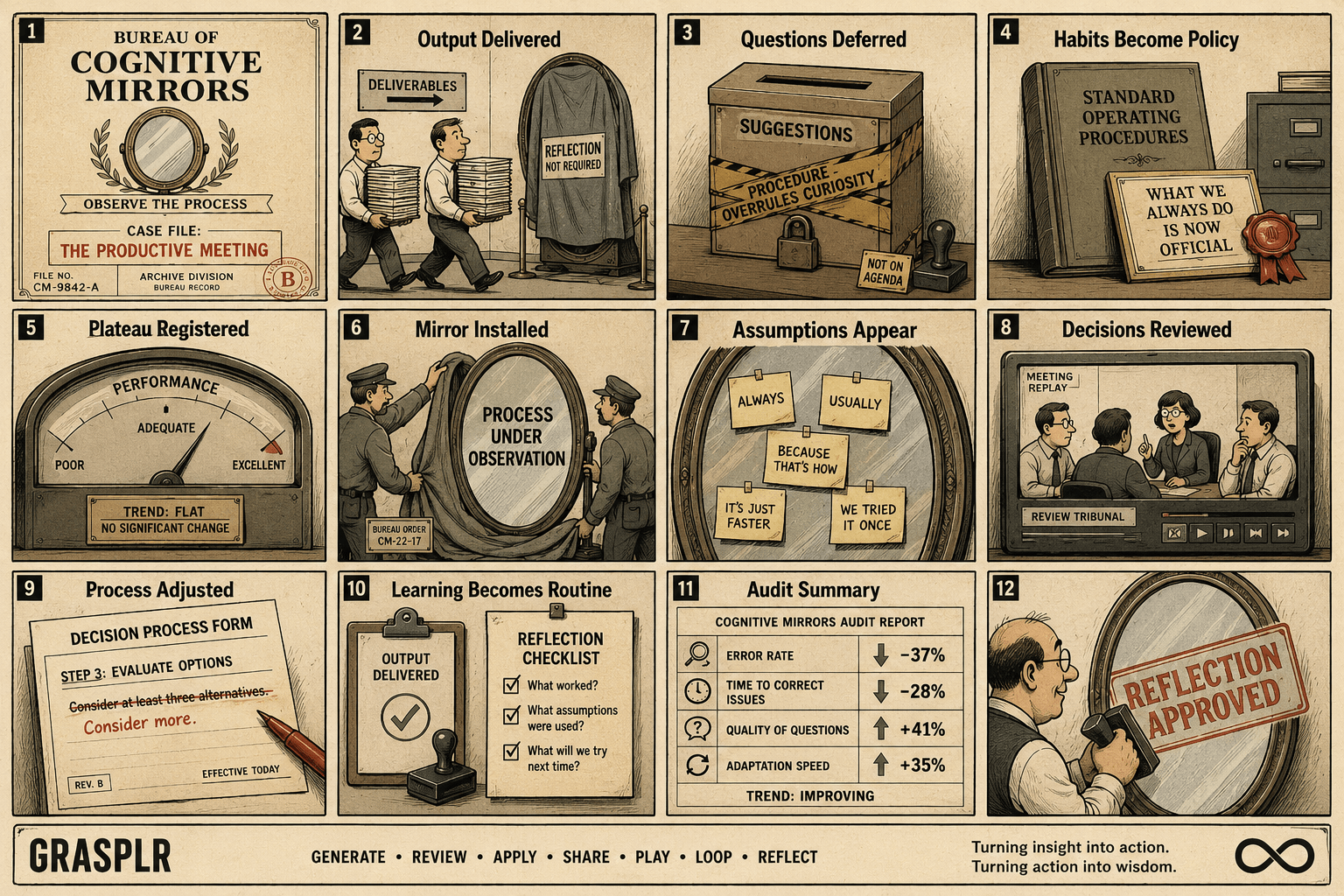
Cognitive Mirrors and Self-Observation Loops
A Cognitive Mirror is any mechanism that helps a system observe and evaluate its own behavior.
Instead of focusing only on outputs, it directs attention toward the processes, decisions, and mental models behind those outputs.
These mirrors can take many forms: retrospectives, performance reviews, audience feedback systems, decision journals, or structured reflection practices. Each creates a feedback loop that reveals not only what happened, but why it happened.
The goal is not self-criticism. The goal is self-awareness.
A system that can observe its own thinking gains the ability to refine it.
Building Reflection Into the System
Metacognitive systems do not rely on occasional insight. They make reflection part of the operating rhythm.
Decision reviews examine the reasoning behind decisions, not just their outcomes.
Pattern audits identify recurring behaviors, assumptions, and blind spots.
Feedback integration converts external signals into internal learning.
Reflection cycles create regular pauses to assess processes before momentum carries problems forward.
These mechanisms work because they make hidden patterns visible while there is still time to adjust.
Awareness Creates Adaptability
The most resilient systems are not the ones that avoid mistakes. They are the ones that detect and correct mistakes quickly.
Cognitive Mirrors turn reflection from an occasional activity into a structural capability. They create environments where learning compounds because observation is built into the process itself.
When a system learns to examine its own thinking, improvement stops depending on chance. It becomes part of the design.
