Coherence Yield – How Much Alignment Your System Produces Per Unit of Supervision

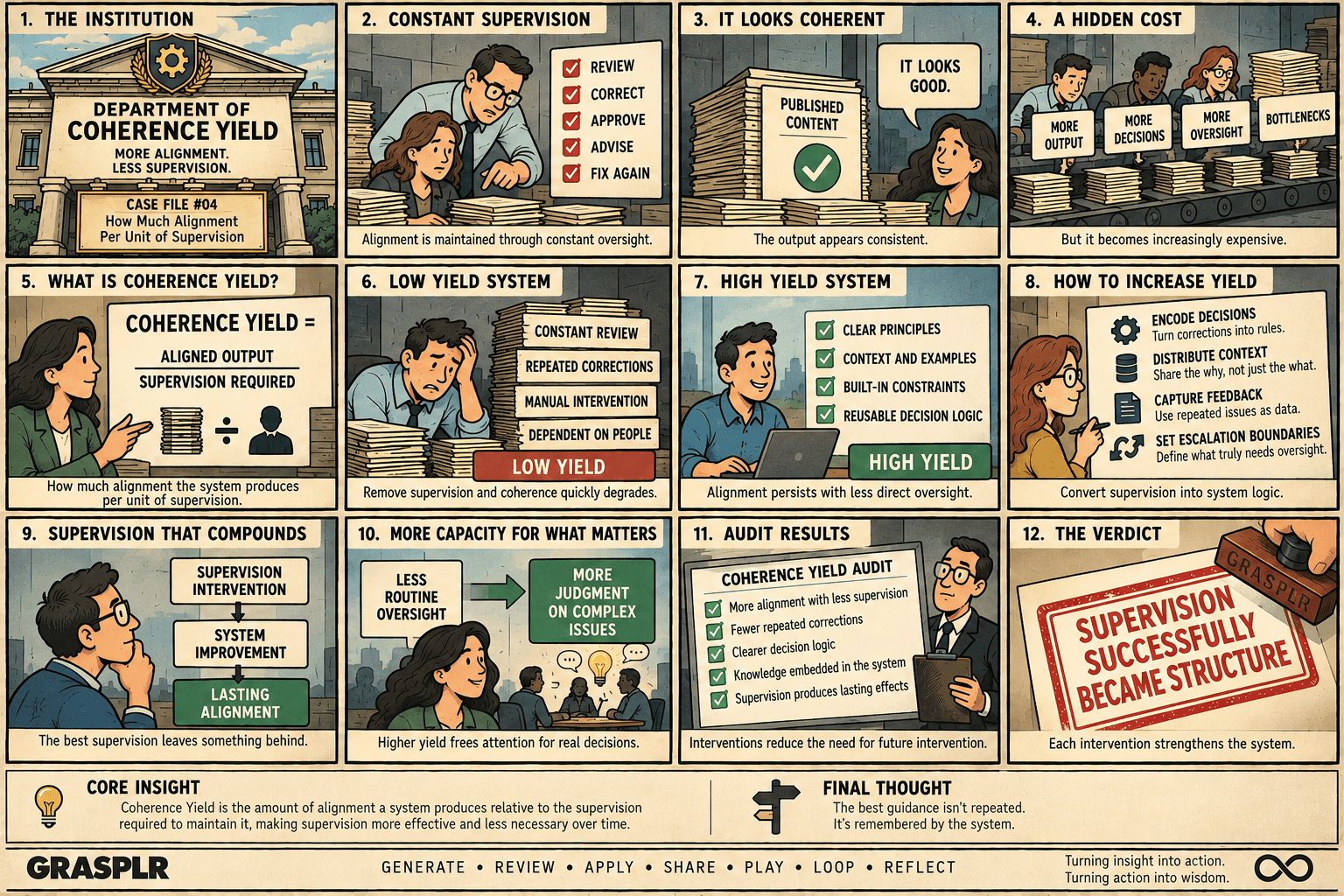
If every decision requires review, correction, or approval, alignment may remain high, but the system is still dependent on supervision. Coherence Yield describes how much alignment the system produces relative to the oversight required to maintain it.
The higher the yield, the more reliably the system can reproduce its intended logic without someone continuously steering it.
Constant Supervision Creates Expensive Consistency
Many systems appear disciplined because someone is always correcting them.
Editors reshape every draft. Managers resolve every ambiguity. Senior operators catch deviations before they become visible. The output looks coherent, but much of that coherence is being supplied manually.
As the system grows, the dependency becomes more expensive. More output creates more decisions. More decisions require more oversight. More oversight creates bottlenecks.
The system hasn’t learned coherence. It has borrowed it from its supervisors.
Coherence Yield as a Measure of System Independence
Coherence Yield is the amount of consistent, aligned behavior a system produces relative to the supervision required to maintain it.
Low-yield systems consume substantial human attention to stay aligned. Reduce that attention and coherence begins to degrade.
High-yield systems behave differently. They embed enough context, constraints, examples, and decision logic that alignment persists even when direct oversight decreases.
This does not eliminate human judgment. It changes where that judgment is spent. Routine alignment moves into the system, leaving human attention available for ambiguity, exceptions, and decisions that genuinely require interpretation.
The goal is not zero supervision. It is to make supervision produce effects that persist beyond the intervention itself.
Designing for Higher Coherence Yield
Start by identifying where supervision repeatedly enters the system. Those interventions reveal where the system still depends on knowledge, judgment, or constraints that have not yet been made transferable.
Decision Encoding: Turn recurring corrections into principles, examples, constraints, or reusable decision rules.
Context Distribution: Give participants enough background to understand not only what the system expects, but why those expectations exist.
Correction Capture: Treat repeated feedback as system data. If the same correction keeps appearing, move the lesson upstream so it can shape future decisions before correction becomes necessary.
Escalation Boundaries: Define which decisions genuinely require supervision and which can remain distributed without weakening alignment.
Each improvement converts part of the system’s recurring supervision into persistent operating logic.
The Best Supervision Leaves Something Behind
Supervision creates temporary coherence when it fixes one output. It creates lasting coherence when the intervention changes how future outputs are produced.
That distinction determines whether supervision compounds or simply repeats.
High Coherence Yield means guidance persists. Corrections become infrastructure. Judgment becomes transferable. Alignment becomes less dependent on the continued presence of the person who originally supplied it.
The strongest systems do not simply require less supervision as they mature.
They turn supervision into structure, so each intervention reduces the need to make the same intervention again.