Complexity Mechanics – How Systems Science Explains the Behavior of Interconnected Worlds

Studying Parts Alone Rarely Explains the Whole
Traditional analysis often breaks problems into smaller and smaller components. While this approach can be useful, it frequently misses the interactions that generate the most important outcomes. An organization is more than its departments. An ecosystem is more than its species. A community is more than its individuals.
When we focus exclusively on components, we risk overlooking the relationships between them. These interactions create behaviors that cannot be understood by examining any single part in isolation. What emerges at the system level is often greater, different, or more surprising than the sum of its pieces.
Complexity Mechanics and the Science of Relationships
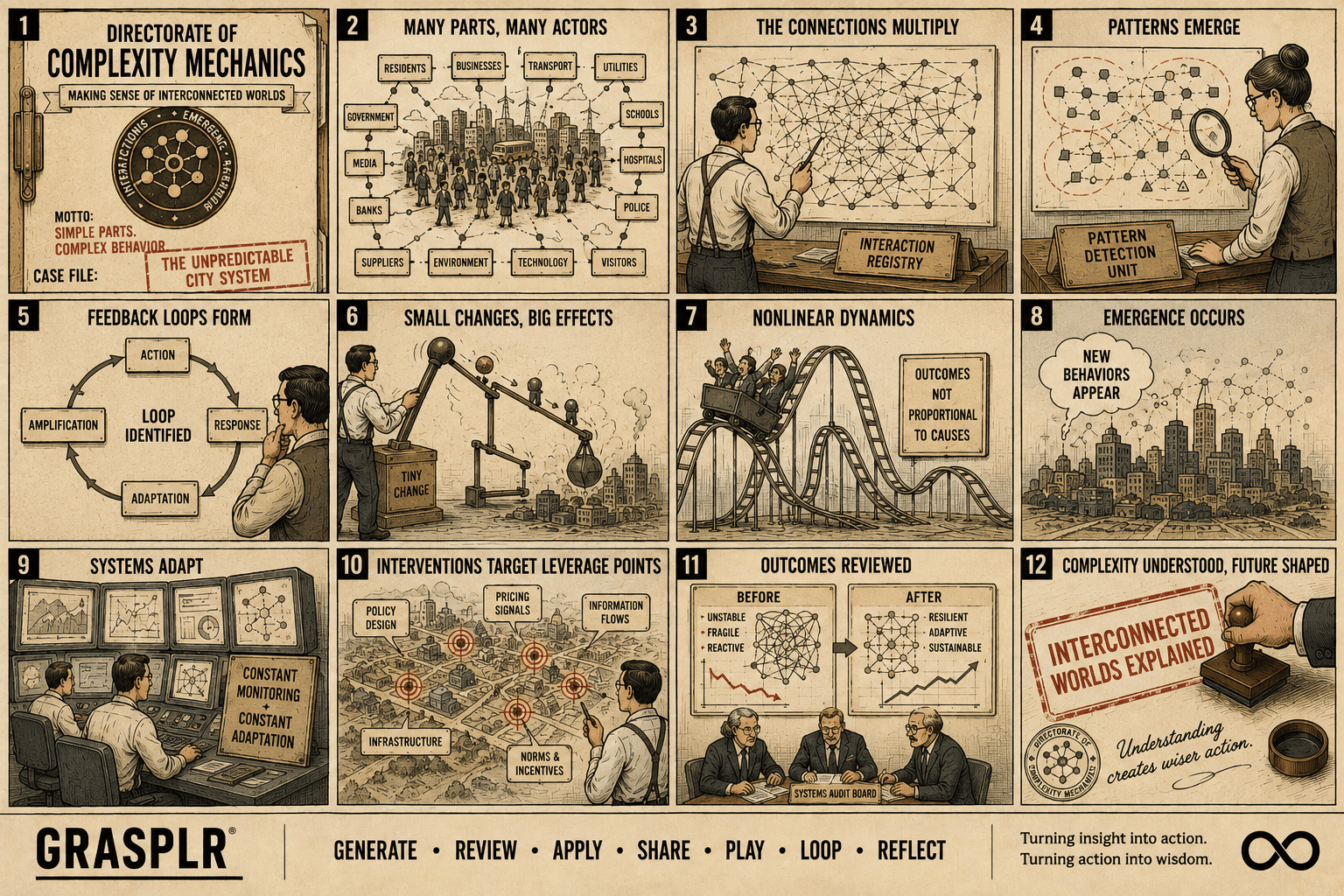
Complexity Mechanics is the central insight of Systems Science: behavior emerges from interaction. Systems are composed of interconnected elements that continuously influence one another through flows of information, resources, energy, and feedback.
Some feedback loops amplify change, creating growth, momentum, or instability. Others balance activity, producing stability and resistance. Delays introduce gaps between action and consequence, often making systems appear unpredictable. Over time, these forces interact to generate patterns that become visible as trends, cycles, and emergent behaviors.
Systems Science seeks to identify these underlying mechanisms. Instead of asking what individual elements are doing, it asks how their relationships create collective outcomes.
Understanding the Forces That Shape Systems
To think like a systems scientist, focus on three foundational dynamics:
- Feedback Structures: Examine how actions influence future actions through reinforcing or balancing loops.
- Interdependence Networks: Identify how changes in one area ripple through connected parts of the system.
- Emergent Behavior: Observe the larger patterns that arise from many small interactions rather than from centralized control.
These dynamics provide a framework for understanding why systems behave the way they do. They shift attention away from isolated events and toward the recurring forces that generate them.
Better Understanding Leads to Better Intervention
The power of Systems Science lies in its ability to transform complexity from mystery into mechanism. When we understand the structures producing behavior, we gain the ability to intervene more intelligently. Instead of reacting to symptoms, we can influence the relationships and feedback loops that shape outcomes over time.
Complexity Mechanics teaches that systems are not random collections of parts. They are organized networks governed by patterns of interaction. The more clearly we understand those patterns, the more effectively we can navigate change, solve problems, and design systems capable of producing sustainable results.