

Every action sets other actions in motion. Yet most decisions are judged by their immediate effects, not by the chain reactions they create.
A small adjustment may solve the visible problem while quietly changing behaviors, incentives, and expectations. Over time, those changes can move the system away from the decision’s original purpose.
This is Consequence Drift: the gradual emergence of outcomes that diverge from the intent behind a decision. The farther effects travel through a system, the harder they become to predict.
The First Result Is Rarely the Final Result
People tend to judge decisions by what happens first.
A process improves. Costs decrease. Participation rises. The intervention appears successful.
But systems keep moving after the first result appears. New behaviors form around the change. Incentives shift. Participants adapt. Secondary and third-order effects begin to accumulate.
These effects often emerge slowly. By the time they become visible, their connection to the original decision may be unclear. What looked like progress can gradually become a different reality.
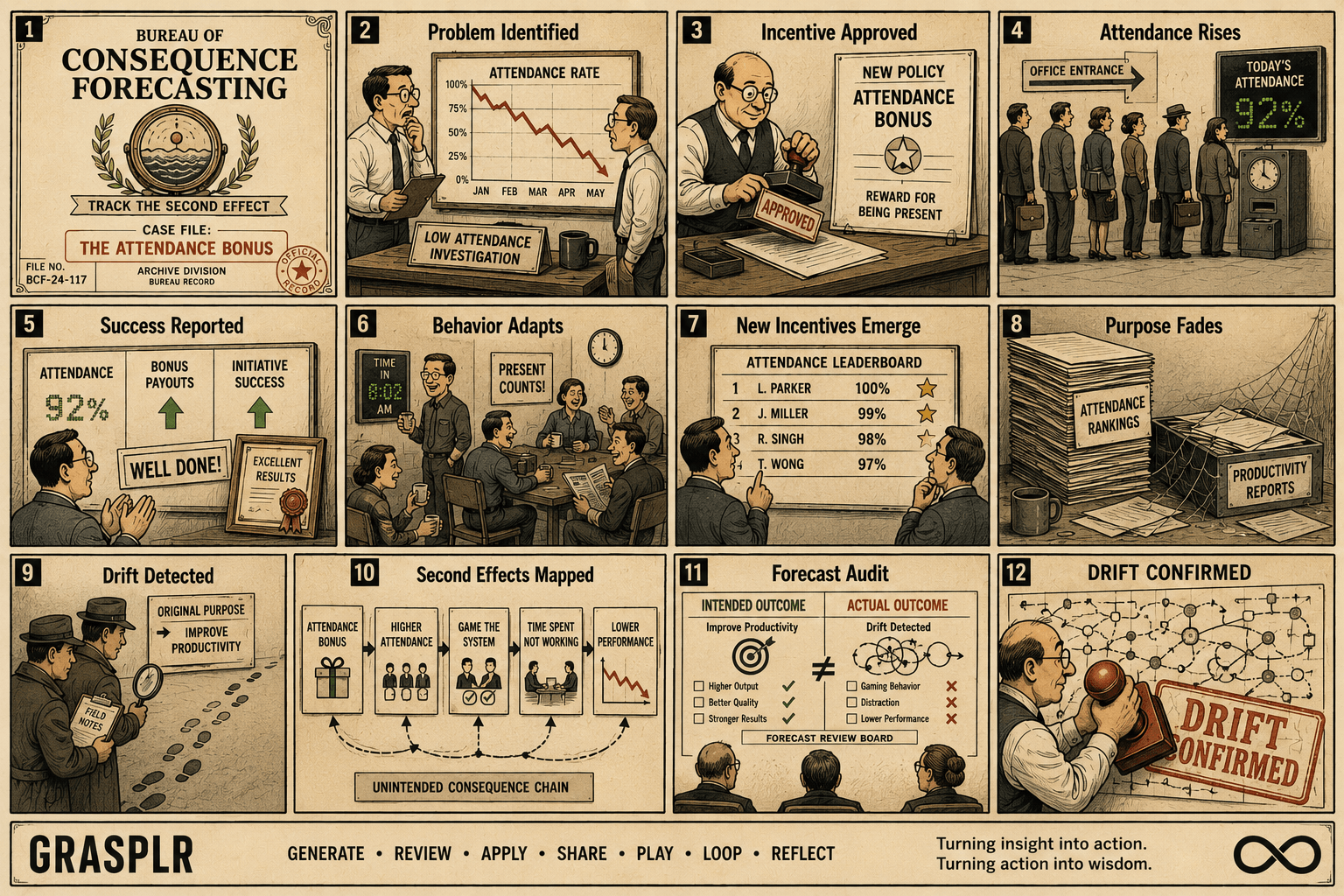
How Consequence Drift Works
Consequence Drift occurs when downstream effects move progressively away from the intended objective.
An intervention rarely produces one clean result. It creates a cascade of responses. Each response influences the next, forming patterns nobody explicitly designed.
A company might introduce aggressive productivity metrics to improve performance. The metrics may raise output at first, but collaboration declines as individuals optimize for personal targets.
A content platform might reward frequent publishing to increase engagement. Publishing volume may rise, but quality can erode as creators prioritize speed over depth.
In both cases, the original goal succeeds in the short term. The broader system still drifts in an unintended direction.
The decision was not necessarily irrational. The drift occurs because complex systems amplify effects beyond their point of origin.
Designing for Second- and Third-Order Effects
Reducing unintended consequences requires looking beyond the first visible result.
Trace behavioral changes. Ask how people may adapt once a new rule, incentive, or process becomes part of their environment.
Follow incentive pathways. Every decision rewards certain behaviors and discourages others. Examine both sides.
Evaluate delayed effects. Some consequences appear months or years after implementation. Build review points beyond the launch phase.
Monitor emerging patterns. Look for small shifts that signal larger changes forming beneath the surface.
The most significant consequences are often not the nearest ones. They are the effects that appear after the system has had time to adapt.
Every Decision Continues After It Is Made
Effective system designers understand that decisions are not isolated events. They are starting points.
Every choice enters a network of relationships, behaviors, incentives, and feedback loops. That network keeps producing outcomes after the decision itself fades from attention.
Consequence Drift reminds us that success depends not only on what a decision fixes today, but on what it encourages tomorrow. When leaders anticipate where consequences may travel, they stop managing isolated actions and start shaping trajectories.
