Fluency Traps – Why Familiar Content Often Creates False Understanding

Easy Reading Isn’t the Same as Deep Learning
Many creators mistake immediate clarity for lasting understanding. If an article flows effortlessly or a presentation earns plenty of nods, it’s tempting to assume the message has landed. In reality, audiences often confuse recognition with retention. Familiar ideas create a comforting sense of confidence, but that confidence quickly fades when they’re asked to explain the concept or use it in a new situation. The problem isn’t poor communication—it’s mistaking fluency for learning.
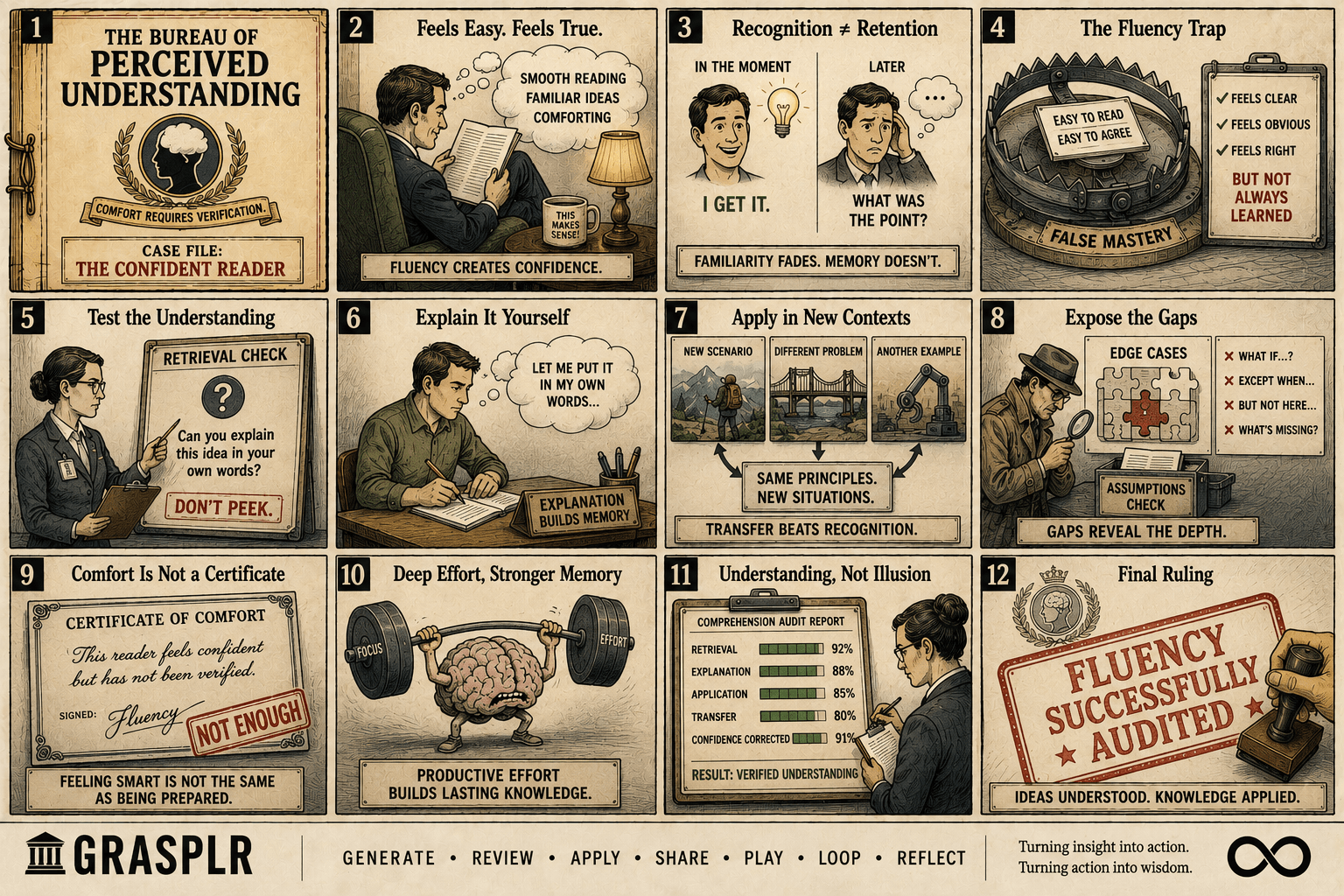
Fluency Traps and the Illusion of Mastery
A Fluency Trap occurs when content is so effortless to consume that audiences overestimate how well they’ve understood it. The smoother the experience, the less the brain is required to retrieve, organize, or reconstruct knowledge. Effective content systems balance clarity with productive cognitive effort, encouraging readers to think rather than simply agree. The goal isn’t to make ideas difficult—it is to make understanding durable.
Designing Beyond Passive Recognition
Build your content to challenge understanding without sacrificing accessibility.
- Pause for Reflection: Ask questions before providing answers so readers test what they already know.
- Encourage Explanation: Invite audiences to summarize concepts in their own words rather than simply rereading them.
- Vary the Context: Reintroduce ideas in different scenarios that require transfer instead of repetition.
- Reveal Hidden Gaps: Present examples or edge cases that expose assumptions and deepen comprehension.
Like walking a familiar path, recognition feels effortless—but true navigation begins when the map is taken away.
Measure Understanding, Not Comfort
The most valuable content doesn’t simply feel memorable—it becomes usable. Fluency Traps remind us that confidence can be misleading when it isn’t supported by retrieval and application. By designing experiences that require audiences to think, recall, and adapt, you transform passive readers into active learners. In the end, influence comes not from making ideas feel obvious, but from making them impossible to forget.