
Most people believe they are evaluating reality objectively. They are not. Every person, institution, culture, and civilization interprets the world through a set of assumptions about power, truth, responsibility, risk, success, and meaning.
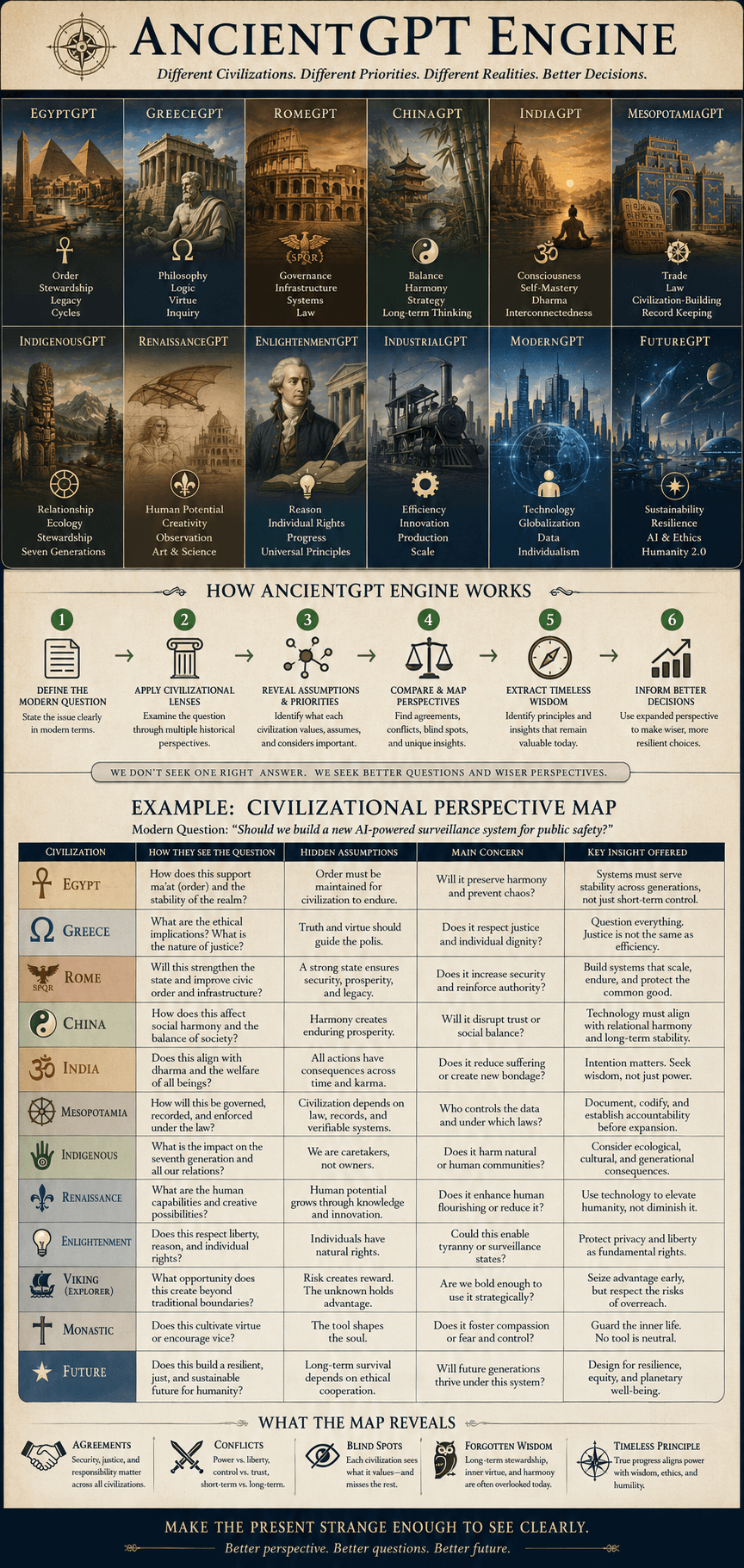
These assumptions become so familiar that they disappear from view. The AncientGPT Engine exposes those hidden worldviews by examining modern questions through the perspectives of different civilizations and historical eras. What appears to be one problem often becomes many different problems depending on who is looking at it.
Every Civilization Lives Inside a Different Reality
- A modern entrepreneur sees market opportunity.
- A Roman sees infrastructure and power.
- A Spartan sees discipline.
- A Confucian scholar sees social harmony.
- A Viking sees risk and reward.
- A medieval monk sees moral consequence.
- The situation remains the same.
- The interpretation changes.
This happens because civilizations optimize for different priorities. What a society values determines what it notices. What it notices determines what it believes matters. Over time, these priorities become a worldview—a cognitive architecture for interpreting reality itself.
- Most disagreements are not disagreements about facts.
- They are disagreements between worldviews.
AncientGPT Reveals the Assumptions Hidden Beneath Modern Thinking
The AncientGPT Engine is a framework for exploring a modern challenge, decision, opportunity, or question through the lenses of different civilizations and historical periods.
Instead of asking:
“What is the right answer?”
It asks:
“How would different civilizations understand the question?”
This shift creates perspective diversity.
- A business problem becomes a governance problem for Rome.
- A virtue problem for the Stoics.
- A harmony problem for Confucian scholars.
- A freedom problem for Enlightenment thinkers.
- A stewardship problem for indigenous cultures.
- A resilience problem for Sparta.
Each perspective reveals assumptions hidden within the others.
The goal is not to determine which civilization was correct.
The goal is to uncover what each civilization noticed that modern thinking may have forgotten.
Conducting a Civilizational Perspective Map
To explore a question through AncientGPT, examine it through multiple historical lenses:
- Roman Lens: How does this affect stability, power, governance, and long-term durability?
- Athenian Lens: What assumptions deserve examination? What deeper questions remain unresolved?
- Spartan Lens: Does this create strength, resilience, and self-sufficiency?
- Confucian Lens: How does this affect relationships, obligations, and social harmony?
- Viking Lens: What opportunities exist beyond accepted boundaries? What risks are worth taking?
- Monastic Lens: What effect does this have on character, discipline, and meaning?
- Indigenous Stewardship Lens: What consequences emerge across generations?
- Enlightenment Lens: Does this increase liberty, agency, and individual choice?
As these perspectives accumulate, a Civilizational Perspective Map begins to emerge.
The question becomes larger than the answer.
It becomes a study of competing ways to see reality.
Wisdom Emerges Where Perspectives Intersect
Modern thinking often treats progress as the replacement of old ideas with new ones.
AncientGPT operates differently.
It assumes that civilizations survive long enough to matter because they discover something important about reality. Rome understands systems. Athens understands inquiry. Sparta understands resilience. Confucius understands relationships. Indigenous cultures understand continuity.
No civilization sees everything.
Every civilization sees something.
The value lies not in choosing a single perspective but in understanding the strengths and blind spots of each.
When multiple worldviews converge on the same principle, that principle often contains durable wisdom.
Civilizational Perspective Map
Every AncientGPT analysis should reveal:
- Modern Question: What issue is being examined?
- Civilizational Interpretations: How would different historical cultures understand it?
- Hidden Assumptions: What worldview assumptions become visible?
- Points of Agreement: What concerns appear across multiple civilizations?
- Points of Conflict: Where do perspectives fundamentally disagree?
- Forgotten Wisdom: What valuable insight has modern thinking overlooked?
- Timeless Principle: What lesson remains useful regardless of era?
The purpose of AncientGPT is not to travel into the past.
It is to make the present strange enough to see clearly.
Because sometimes the fastest way to understand the future is to ask how the past would have interpreted it.