Mechanic Illusion – Why Complex Systems Cannot Be Fixed Like Machines

But complex human systems do not behave like simple machines.
They are shaped by people, relationships, memory, pressure, emotion, feedback, and changing context.
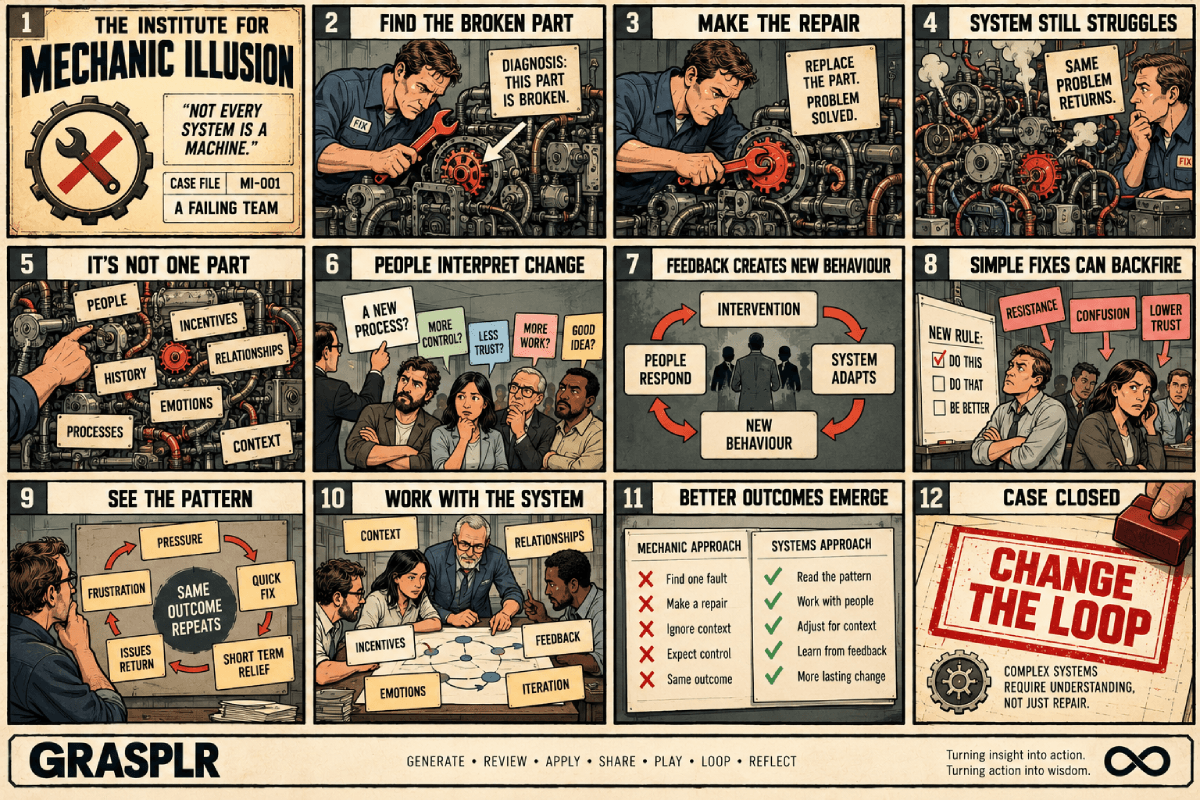
The Illusion of the Master Mechanic is the belief that every system can be controlled through diagnosis and repair, when many systems require interpretation, participation, and ongoing adjustment instead.
Human Systems Do Not Break in One Place
Mechanical thinking looks for a single fault.
If performance drops, someone must be underperforming. If communication fails, one process must be broken. If culture feels strained, one policy must be missing.
This kind of thinking appeals because it promises clean solutions.
But human systems rarely fail through one isolated part.
A communication problem may involve unclear roles, emotional history, platform overload, incentive mismatch, and decision fatigue.
A stalled strategy may involve competing priorities, hidden fear, weak feedback, and a rhythm the team cannot sustain.
Fixing one visible piece may help, but it may also miss the deeper pattern that keeps recreating the issue.
The problem is not that repair is useless.
The problem is assuming repair is enough.
System Interpretation Over Mechanical Control
System Interpretation is the practice of reading a human system as a living field of relationships rather than a machine waiting for adjustment.
It recognizes that people respond, adapt, resist, protect, remember, and reinterpret every intervention placed inside the system.
Human systems reinterpret intervention because change carries meaning. A new rule may feel like clarity to one person and mistrust to another. A new process may reduce confusion while also shifting authority. A new target may create momentum while increasing fear.
Think of it as entering a conversation, not opening an engine.
In a machine, a part performs its function whether or not it understands the mechanic.
In a human system, every change creates meaning.
People ask what the change signals, who benefits, what is being blamed, what is being protected, and what may be lost.
The intervention becomes part of the system’s behavior.
This shifts the question from “What part do we fix?”
You begin asking, “What pattern are we participating in, and how will the system respond when we move?”
Moving From Repair to Participation
To work with complex systems, replace the mechanic’s certainty with systems literacy.
The goal is not to abandon action. The goal is to make action responsive to the system’s reality.
- Pattern reading: Look for repeated outcomes instead of isolated defects. Patterns reveal the structure that simple fixes often miss.
- Context awareness: Notice the conditions surrounding the behavior: pressure, history, incentives, trust, timing, and constraints. Human systems change according to context.
- Meaning signals: Watch how people interpret the intervention itself. A change can be technically sound and still fail if its meaning creates fear, resentment, or confusion.
- Feedback listening: Treat response as information. Resistance, delay, disengagement, relief, and adaptation all show how the system is absorbing the change.
- Iterative adjustment: Move in smaller, smarter cycles. Complex systems often need sensing and correction, not one heroic repair.
These practices turn change from mechanical fixing into relational intelligence.
You stop acting on the system from outside and begin working with the system from within.
Strong Change Requires More Than the Right Tool
Healthy systems are not restored by a master mechanic standing above them with perfect control.
They improve when people learn to read, participate, adjust, and respond.
The Illusion of the Master Mechanic teaches that complex human systems cannot be reduced to broken parts and simple repairs.
When you let go of the mechanic fantasy, you do not become less capable.
You become more accurate.
You stop forcing machine logic onto living complexity.
You begin designing interventions that account for meaning, feedback, trust, rhythm, and adaptation.
Some systems can be repaired.
Human systems must be understood, entered, and shaped with care.