
Not every problem is a pattern.
Some issues appear once, get resolved, and never return.
But when the same difficulty keeps showing up across people, projects, decisions, or moments, it is no longer just a problem. It is the system revealing itself.
The Difference Between a Problem and a Pattern teaches you to look beyond the immediate issue and ask whether the system is producing the same outcome again and again.
A Problem Can Be Fixed Without Changing the System
Most people treat every disruption as something to solve quickly.
A missed deadline needs a new date. A customer complaint needs a response. A broken process needs a workaround. A confused team needs clarification.
Sometimes that is enough.
Some problems are local, temporary, and specific.
But recurring issues require deeper reading.
If deadlines keep slipping, customers keep asking the same question, teams keep misunderstanding priorities, or the same conflict keeps returning in new language, the issue is no longer isolated.
Solving it once may reduce the immediate pain, but it will not change the conditions that keep bringing it back.
A problem asks, “What needs attention right now?”
A pattern asks, “What is the system arranged to repeat?”
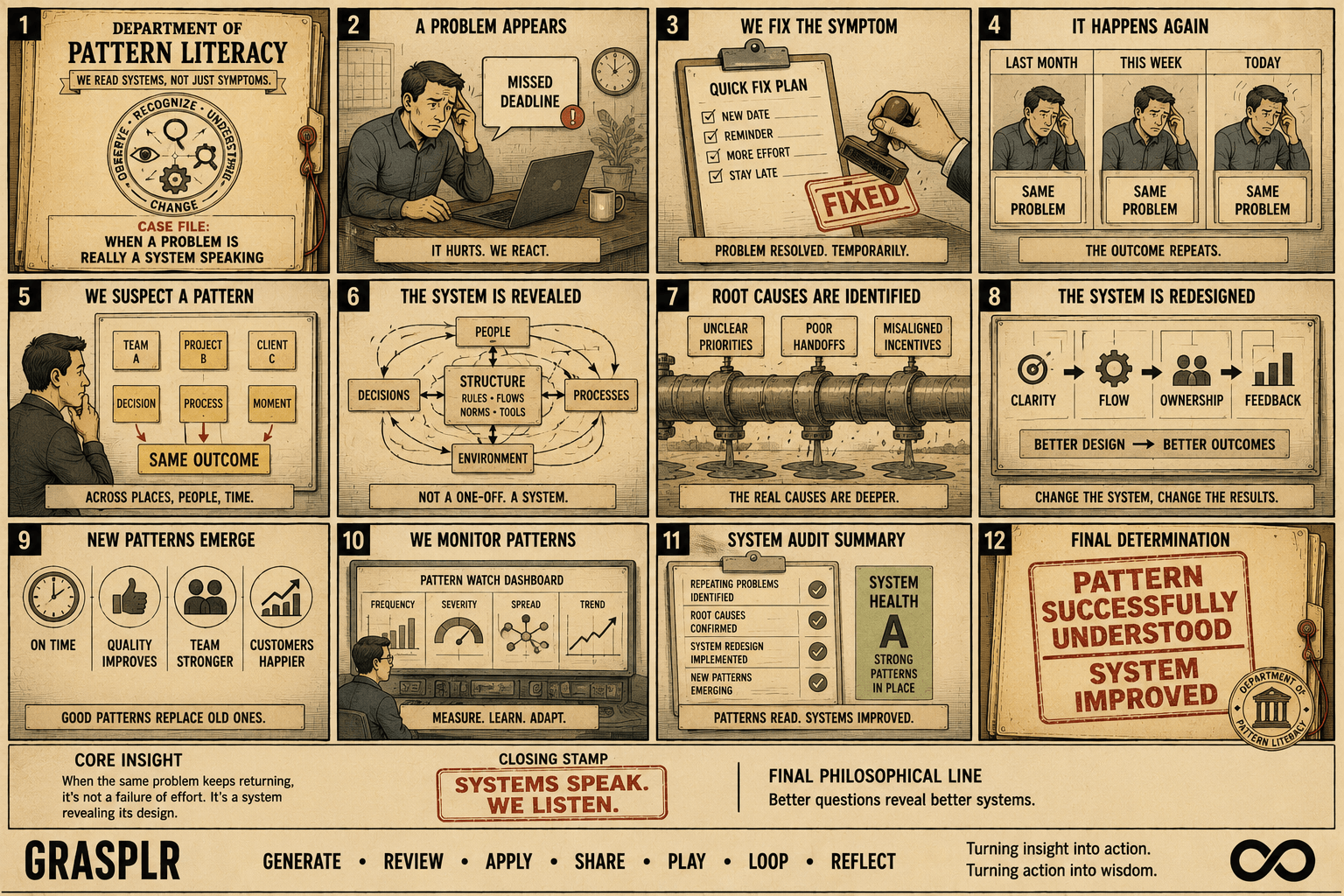
Pattern Literacy as System Reading
Pattern Literacy is the ability to distinguish between a one-time issue and recurring system behavior.
It teaches you to look for repetition, distribution, timing, triggers, and reinforcement before deciding what kind of response is needed.
Repetition turns an issue into evidence when the same difficulty survives different people, moments, or attempted fixes. At that point, the issue is not only what happened. It is what the system keeps making likely.
Think of it as knowing whether you are wiping up a spill or fixing a leak.
A spill may need quick cleanup.
A leak requires understanding the structure behind the damage.
Treat a leak like a spill, and the same mess will return. Treat every spill like a leak, and you may overcomplicate simple problems.
Systems Literacy helps you read the difference.
This shifts the question from “How do we solve this?”
You begin asking, “Is this an event, or is this evidence?”
Reading the Difference Between One Issue and Many
To tell whether you are dealing with a problem or a pattern, study the issue across time and context.
Patterns leave traces.
- Frequency signals: Ask how often the issue appears. A single occurrence may be a problem. Repeated occurrences suggest a pattern.
- Context spread: Notice whether the issue appears in one place or across multiple teams, channels, relationships, or decisions. Patterns often travel.
- Trigger points: Look for what tends to happen before the issue appears. Pressure, ambiguity, scarcity, speed, or unclear ownership may be activating the same result.
- Response history: Review what has already been tried. If the same solution keeps being applied and the issue keeps returning, the system has not yet changed.
- Reinforcement loops: Identify what allows the pattern to continue. Incentives, defaults, habits, tools, rules, or emotional payoffs may be keeping it alive.
When these signals become visible, your response becomes more precise.
You stop using quick fixes where structural change is needed, and you stop redesigning systems where a simple repair would do.
Problems Need Solutions; Patterns Need Literacy
Strong systems thinkers do not ignore problems.
They solve them at the right level.
The Difference Between a Problem and a Pattern shows that isolated issues may need action, but recurring outcomes need interpretation.
When you read for pattern, you see what the system is practicing.
You notice the repeated question behind the complaint, the recurring delay behind the deadline, the familiar tension behind the conflict, and the structural reinforcement behind the behavior.
A problem may be solved once.
A pattern must be understood until the system no longer needs to produce it.