
Personal change rarely fails because people do not care enough.
Habits, identity, motivation, and self-improvement all live inside systems of cues, environments, rewards, pressures, memories, and relationships.
Systems Literacy for Personal Change means reading the structures that shape your behavior before blaming yourself for not trying harder.
Willpower may start change, but systems decide whether change can survive.
Willpower Weakens When the System Stays the Same
Most self-improvement advice focuses on effort.
Be more disciplined. Stay motivated. Make a stronger commitment. Choose better. Push harder.
These ideas can help for a moment, but they often collapse when daily life returns to its familiar shape.
A person may want to rest more while their schedule rewards constant availability. They may want to eat better while their environment makes rushed choices easiest. They may want to become more confident while their relationships keep reinforcing an old identity. They may want to focus deeply while their tools, notifications, and obligations keep training distraction.
The problem is not always weak intention.
Often, the old system is still stronger than the new decision.
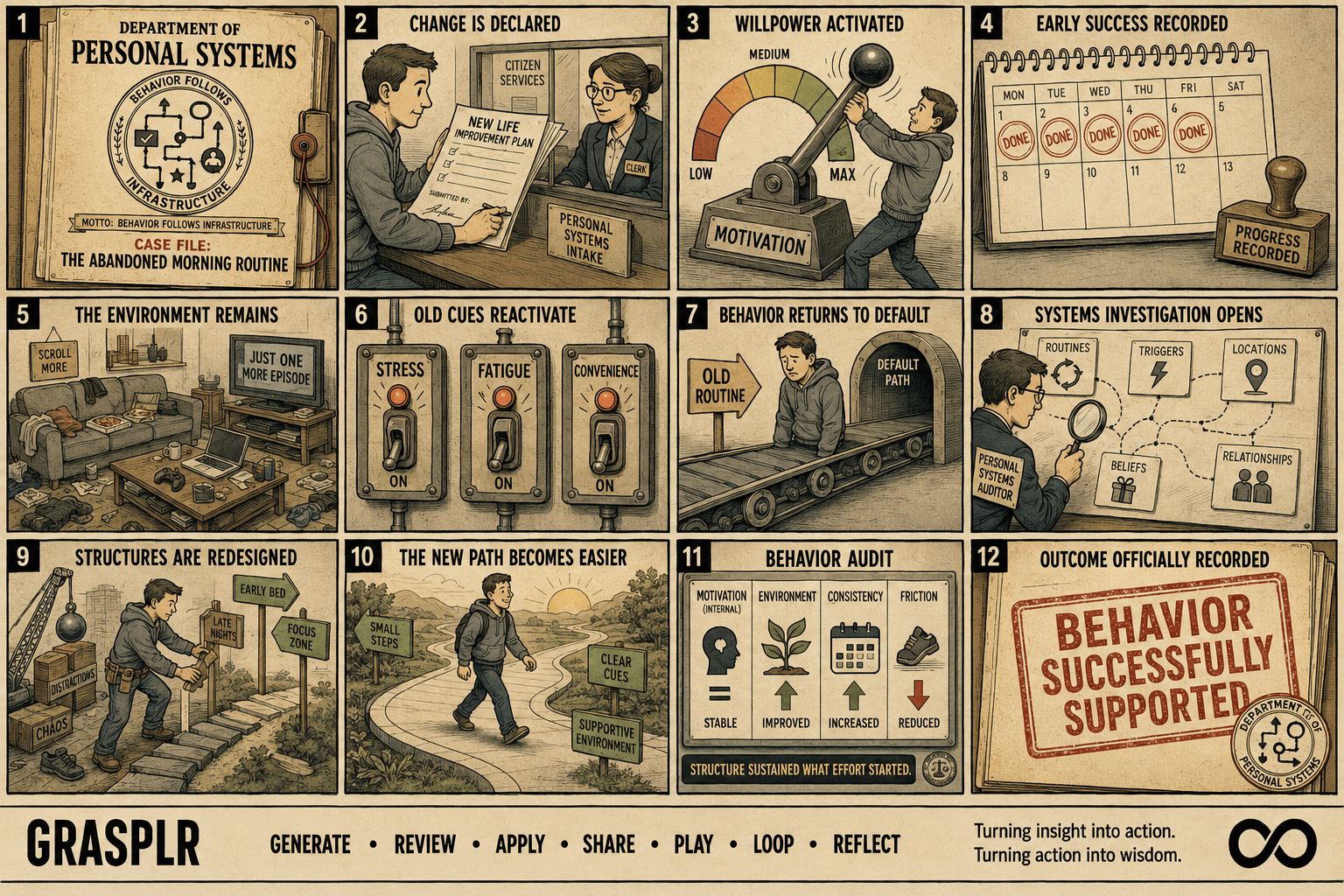
Personal System Literacy as Behavior Design
Personal System Literacy is the practice of reading the conditions that make your behavior more likely.
It looks at habits, identity, motivation, and self-improvement as patterns shaped by structure, not just private choices made in isolation.
Old conditions keep training old behavior because they keep sending the same signals. The same cue appears. The same reward is available. The same relationship names you the same way. The same environment makes the old action easier than the new one.
Think of it as designing the field your future self will move through.
Your behavior is shaped by what is visible, easy, rewarded, familiar, safe, and repeated.
If the system around you keeps supporting the old pattern, the new identity has nowhere to land.
Change becomes more sustainable when your surroundings, routines, relationships, and rewards begin teaching the behavior you want to practice.
This shifts the question from “Why can’t I make myself change?”
You begin asking, “What system is making the old behavior easier than the new one?”
Reading the Structures Behind Personal Change
To change more intelligently, look beyond the goal and study the system around it.
Personal patterns become easier to shift when their supports are visible.
- Cue patterns: Notice what triggers the behavior before it happens. Time of day, emotion, place, people, fatigue, and stress can all act as quiet instructions.
- Environment paths: Study what your surroundings make easy or difficult. A well-designed environment reduces the need for constant self-control.
- Reward loops: Identify what the old behavior gives you: comfort, relief, control, belonging, stimulation, avoidance, or certainty. Habits repeat because they serve something.
- Identity signals: Watch the stories you keep receiving and repeating about who you are. Change becomes harder when your environment keeps naming you as the old version of yourself.
- Motivation rhythms: Track when your energy naturally rises, drops, or needs recovery. Sustainable change works with rhythm instead of demanding intensity every day.
- Reinforcement structures: Ask what happens after you practice the new behavior.
Progress strengthens when it is noticed, rewarded, repeated, and protected.
Once these structures become visible, self-improvement becomes less about forcing yourself and more about reshaping the conditions that train you.
Change Yourself by Changing the System Around You
Systems Literacy turns personal change from a battle of willpower into a practice of design.
It teaches that habits, identity, motivation, and self-improvement are shaped by loops of attention, environment, reward, pressure, and reinforcement.
When you read those loops, you stop treating every setback as a character flaw.
You can adjust the cue, remove the friction, protect the rhythm, change the reward, revise the identity signal, and build a structure that makes the next right action easier.
Personal change does not happen only inside you.
It happens around you, through the systems that teach you what to repeat.
Change the system, and the self has a better place to grow.