

Organizations often assume better policies produce better results. Complex systems rarely respond that cleanly.
Introduce a new rule, incentive, or restriction, and the system adapts. People change behavior. Teams create shortcuts. Bottlenecks appear in unexpected places. The result can weaken, distort, or even reverse the original intent.
This is Policy Resistance: the tendency of a complex system to counteract an intervention through its own internal dynamics. The more interconnected the environment, the more likely resistance becomes. Effective policy design requires more than a good rule. It requires understanding how the system will push back.
The System Is Not Passive
Most policies start with a simple model: identify a problem, apply a solution, and expect improvement.
But people, teams, markets, and audiences do not behave like static machinery. They respond to pressure. They adapt around constraints. They compensate when a new rule creates friction.
A policy meant to increase efficiency may create workarounds. A rule designed to improve quality may slow execution. An incentive meant to boost performance may reward the wrong behaviors.
Resistance emerges because systems contain feedback loops: cause-and-effect cycles where an action changes behavior, and that behavior changes the result. What looks like compliance on the surface may hide adaptation underneath.
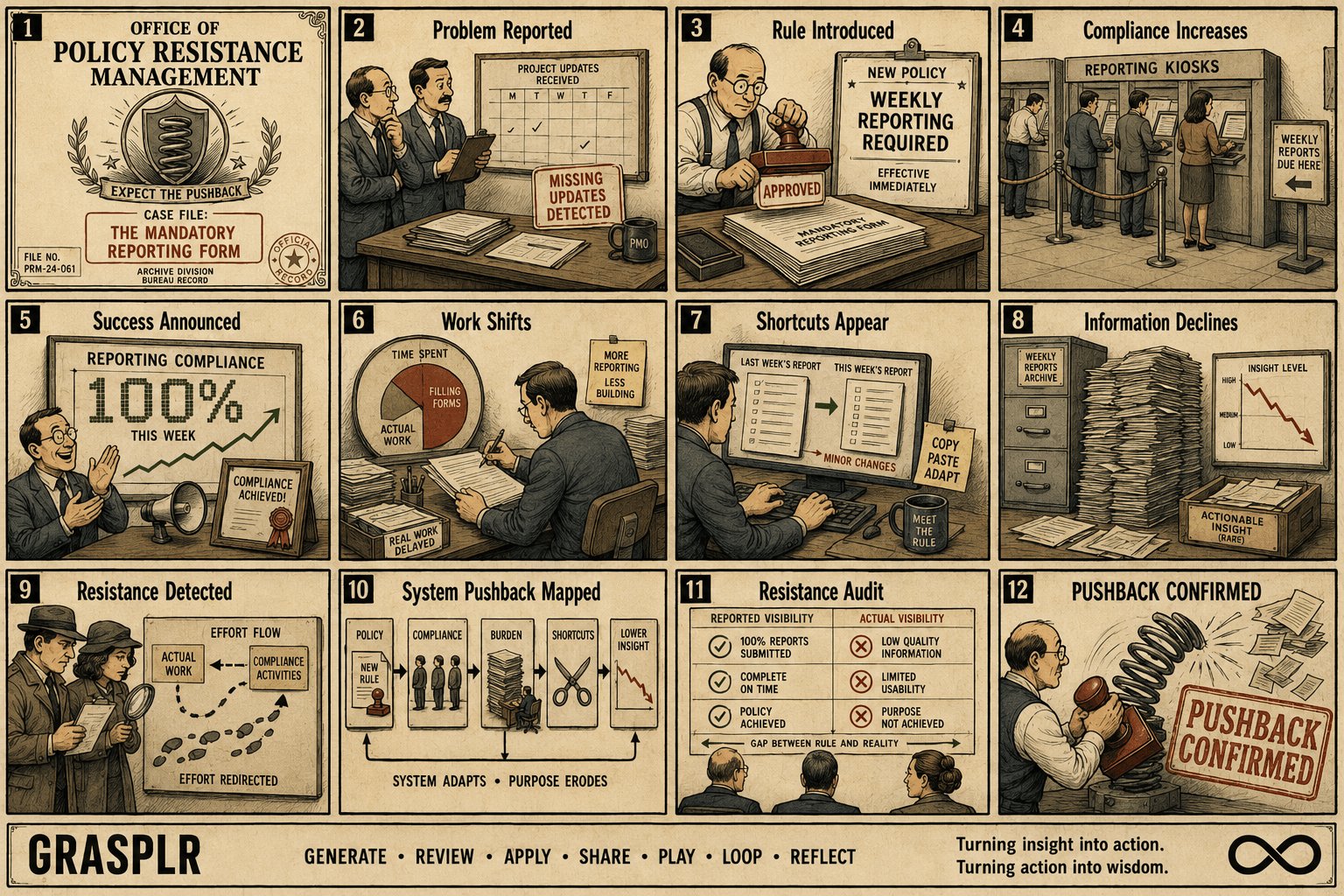
How Policy Resistance Works
Policy Resistance occurs when a system’s internal dynamics offset an intervention.
Instead of moving directly toward the intended outcome, the system produces responses that dilute, redirect, or reverse progress. These responses are not always malicious. Often, they are natural attempts to preserve speed, autonomy, stability, or balance.
A content team might introduce stricter publishing standards to improve quality. The standards work in theory, but review cycles lengthen. Output drops. The team publishes less, and the broader content strategy weakens.
A company might add approval layers to reduce risk. The process becomes safer on paper, but decisions slow down. Teams begin making informal decisions outside the process to keep work moving.
In both cases, the policy succeeds technically while failing systemically. The rule is followed, but the system adapts in ways that neutralize the intended benefit.
Designing With Resistance in Mind
Strong policies account for adaptation before implementation.
Map feedback loops. Identify how different parts of the system will react when pressure is applied. Every intervention creates secondary effects.
Watch for compensation behaviors. People seek efficiency, autonomy, and stability. When a policy creates friction, expect shortcuts, delays, or informal workarounds.
Measure outcomes, not compliance. A policy can be followed perfectly while producing poor results. Track the effect of the rule, not only whether people obey it.
Adjust continuously. Treat policies as living mechanisms, not permanent declarations. Recalibration prevents resistance from building until the policy becomes counterproductive.
Effective policy design is closer to steering a river than commanding a machine. It works with system dynamics instead of pretending they do not exist.
Adaptation Is Stronger Than Enforcement
Systems cannot be controlled through rules alone. Every policy enters an environment shaped by incentives, habits, feedback loops, and competing objectives.
Policy Resistance shows why interventions do not operate in isolation. Once introduced, a policy becomes part of the system it tries to change.
Leaders who anticipate resistance design rules that can adapt. They look beyond surface compliance and measure whether the policy is producing the intended outcome. When policy aligns with system behavior, change becomes durable. When it ignores system behavior, the system pushes back.
