Productive Friction – Why Content That Requires Effort Creates Stronger Understanding

Effort Is Often Mistaken for Poor Design
Many creators believe that every moment of difficulty signals a flaw in their content. They simplify relentlessly, eliminate pauses, and provide answers before audiences have a chance to think. The result is effortless reading—but shallow learning. When understanding requires no mental work, the brain has little reason to strengthen or retain the information. Comfort creates familiarity; effort creates durability.
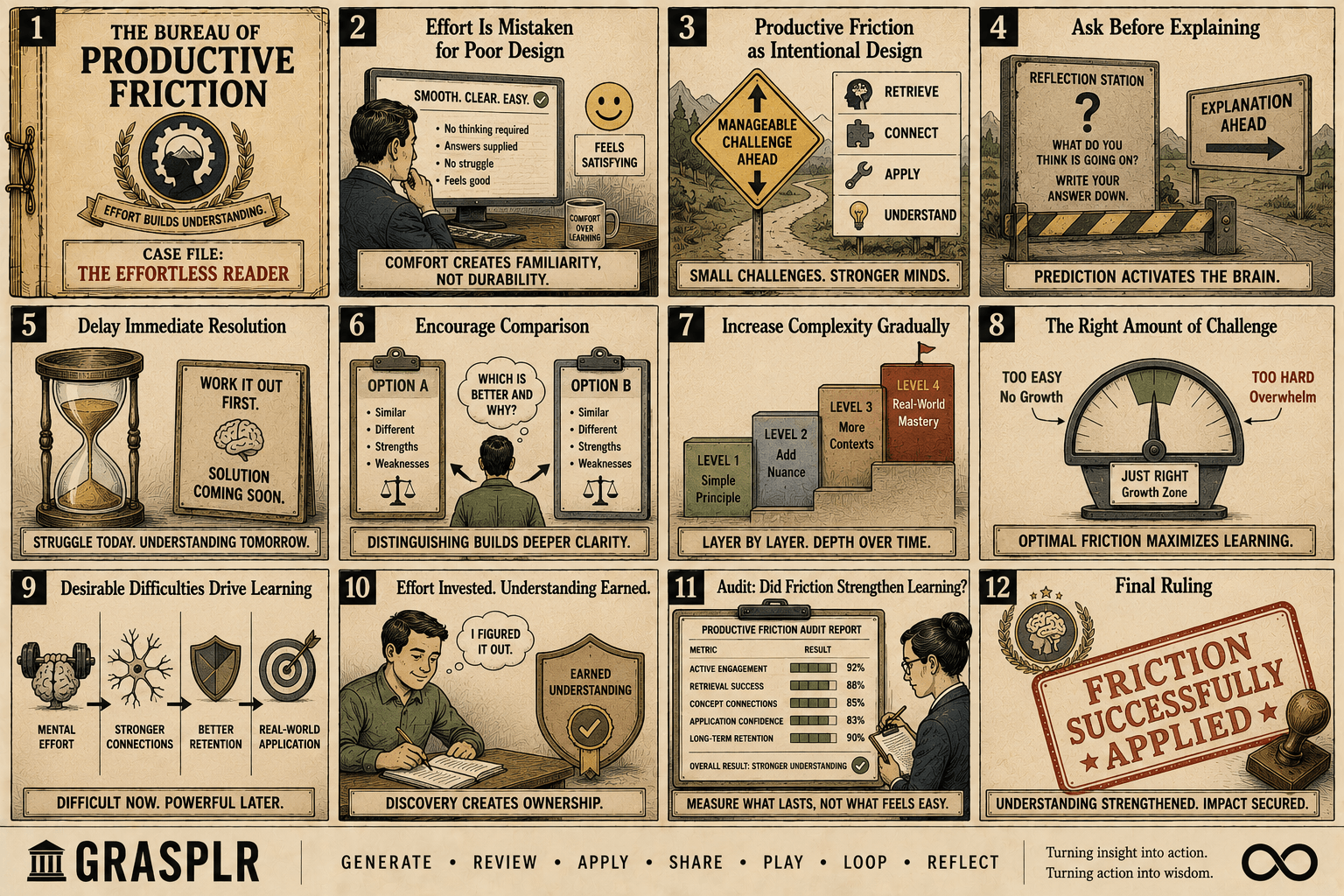
Productive Friction as Intentional Cognitive Design
Productive Friction is the deliberate introduction of manageable challenges that encourage audiences to retrieve, connect, and apply ideas rather than simply consume them. These challenges aren’t barriers—they’re learning accelerators. A reflective question before an explanation, a problem to solve before revealing the framework, or a comparison that forces careful evaluation all require active engagement. By making the mind work just enough, you transform passive readers into active participants.
Designing Challenges That Strengthen Learning
Build your content to invite thought without overwhelming your audience.
- Ask Before Explaining: Present a question that encourages prediction or reflection before revealing the answer.
- Delay Immediate Resolution: Allow readers time to wrestle with a concept before providing the framework.
- Encourage Comparison: Contrast similar ideas so audiences must distinguish meaningful differences.
- Increase Complexity Gradually: Introduce simple principles first, then layer nuance as understanding grows.
Like resistance training, progress comes not from avoiding effort but from applying the right amount at the right time.
The Right Challenge Creates Lasting Influence
The strongest content systems don’t compete to be the easiest—they compete to be the most transformative. Productive Friction turns learning into participation, where each small cognitive challenge strengthens memory, understanding, and application. When your audience invests effort in discovering your ideas instead of merely receiving them, those ideas become more than information—they become knowledge they can carry forward.