

Sometimes a team starts with a clear goal.
Everyone understands what success looks like. Decisions feel straightforward. Work moves in a consistent direction.
But over time something subtle begins to change. New priorities appear. Different stakeholders push for different outcomes. Meetings begin to revolve around resolving competing interpretations of what matters most.
No one officially changed the goal – yet the system no longer moves in a single direction.
This is how drift begins.
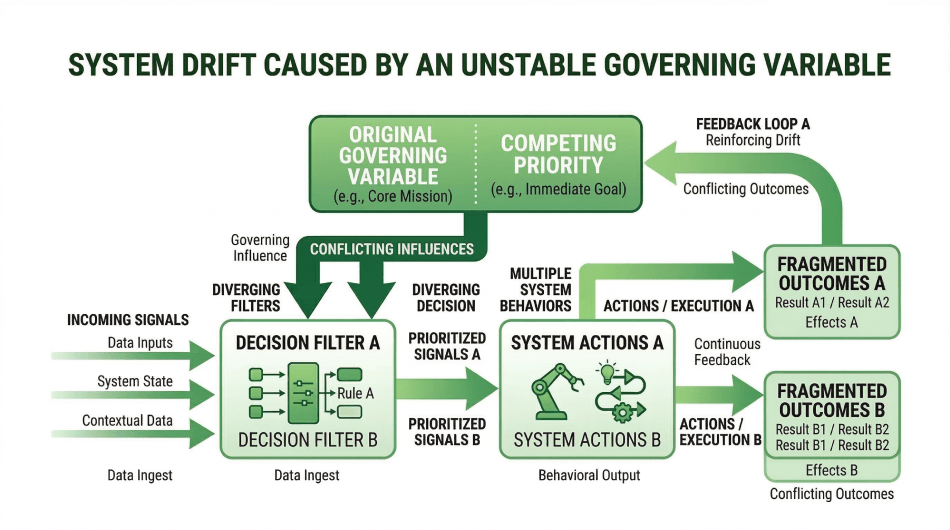
Systems Layer
In Systems Language, drift occurs when the governing variable of a system becomes unstable, ambiguous, or contested.
A system maintains alignment when its governing variable provides a stable reference condition for decisions. This reference condition allows signals to be ranked, filtered, and acted upon consistently.

The most effective intervention is not increased activity or tighter control. It is restoring a clear orientation that stabilizes decision priorities across the system.
Within the five-pillar framework, Orientation functions as the stabilizing reference that prevents structural drift.
