
Improving efficiency feels productive.
Teams streamline workflows, remove bottlenecks, automate tasks, and reduce wasted time. The system starts moving faster and with less friction.
But sometimes, after all the improvements, something unexpected happens.
The system becomes very good at producing results that nobody actually wanted.
The issue isn’t the quality of the improvements. The issue is that the system was optimized before its direction was fully clarified.
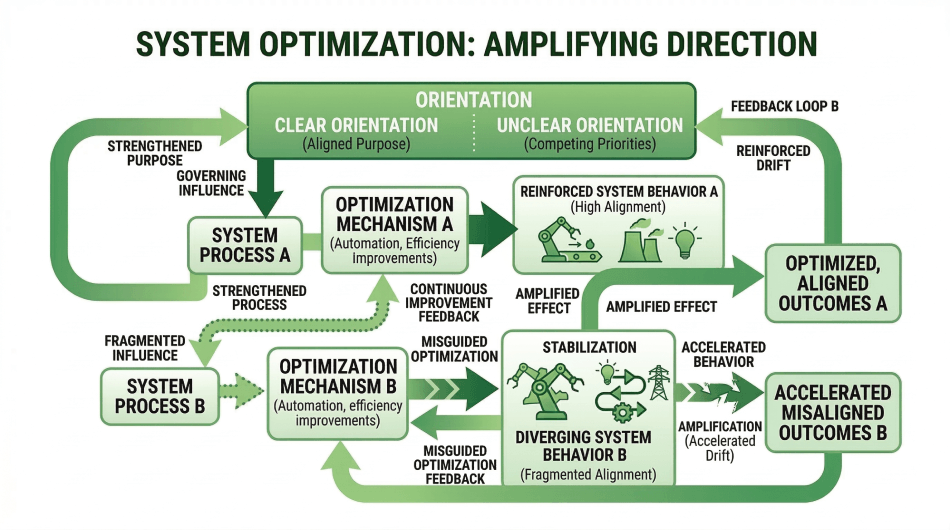
Systems Layer
In Systems Language, optimization amplifies the behavior already stabilized by the system’s governing variables.
Optimization mechanisms – such as automation, efficiency improvements, or process acceleration – increase the system’s capacity to produce outcomes along its current trajectory.

Within the five-pillar framework, Orientation must stabilize the system before optimization mechanisms are introduced.
Direction first. Acceleration second.