
Organizations often try to solve alignment problems by adjusting structure.
New processes are introduced. Teams are reorganized. Tools are upgraded. Reporting systems are redesigned. The goal is to improve coordination so that everyone moves in the same direction.
Yet even after these changes, the same problems sometimes remain.
Teams interpret priorities differently. Tools are used in inconsistent ways. Processes produce mixed results across departments.
The issue is not always the structure itself.
Sometimes the system simply lacks a clearly defined direction.
Systems Layer
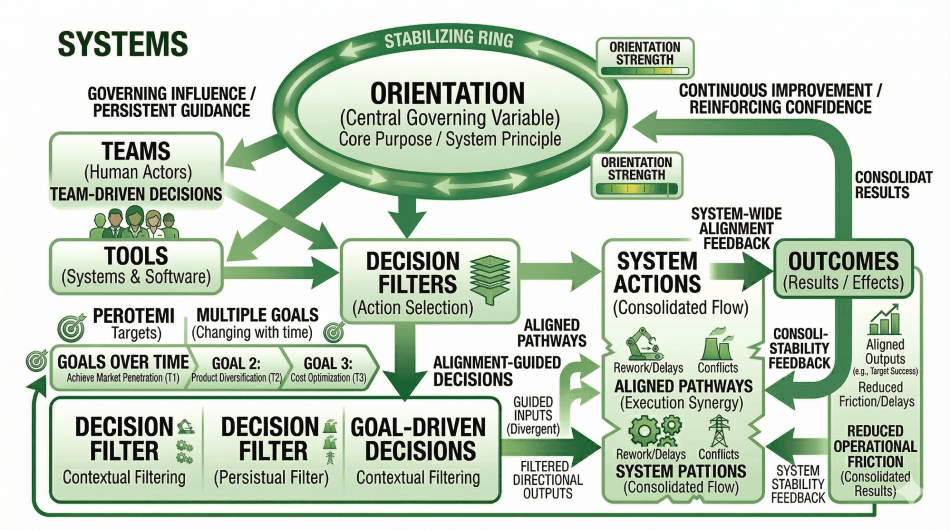
In Systems Language, structural alignment occurs when the components of a system respond consistently to the same governing variable.
These components include teams, processes, tools, and decision frameworks. Each element interprets incoming signals and generates actions within its own operational context.

It emerges when the system’s components respond to the same governing direction.
Within the five-pillar framework, Orientation establishes the central reference that allows teams, tools, and processes to align structurally rather than through constant coordination.