
In many organizations, decision making feels inconsistent.
Two teams face similar situations but reach different conclusions. One manager prioritizes speed while another insists on caution. The process may look correct on paper, yet the outcomes vary depending on who is involved.
To solve this, organizations often add more rules or approval layers.
But consistency rarely comes from more rules. It comes from something deeper – a shared reference that decisions can reliably connect to.
This structural pathway is what we can think of as a decision spine.
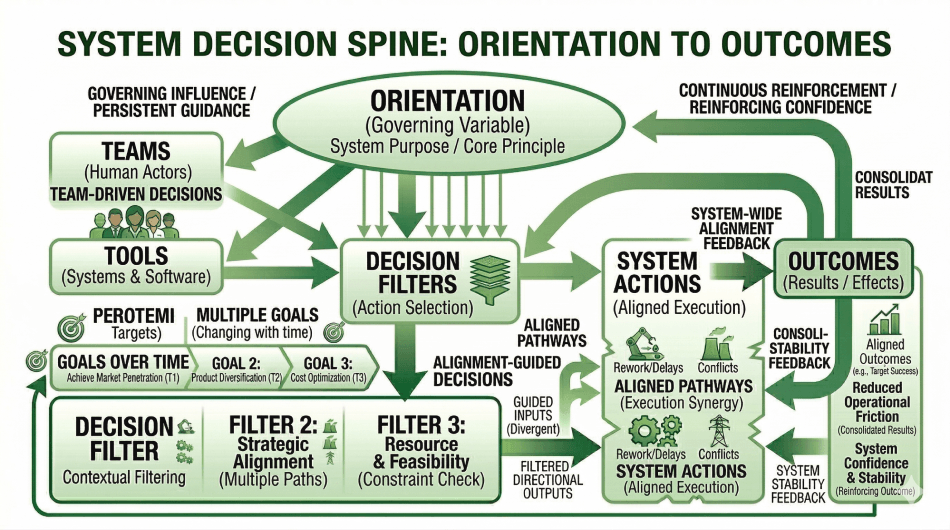
Systems Layer
In Systems Language, a decision spine is the structural pathway through which orientation translates into consistent decisions across the system.
Orientation establishes the governing variable that defines what the system prioritizes. However, for this governing variable to influence behavior, it must be connected to the system’s decision mechanisms.

Direction must be structurally connected to decision-making.
Within the five-pillar framework, Orientation establishes the governing variable, and the decision spine ensures that this orientation consistently guides actions throughout the system.