
Sometimes an organization appears coordinated on the surface but behaves inconsistently underneath.
The marketing team pushes for rapid growth. The operations team focuses on reliability. Finance emphasizes cost control. Product teams prioritize innovation.
Each group is making rational decisions based on its own priorities.
Yet across the organization, the results begin to conflict. Projects slow down. Decisions require repeated negotiation. Teams feel like they are pulling in different directions.
This is not necessarily a problem of effort or communication.
Often it is a problem of competing orientations.
Systems Layer
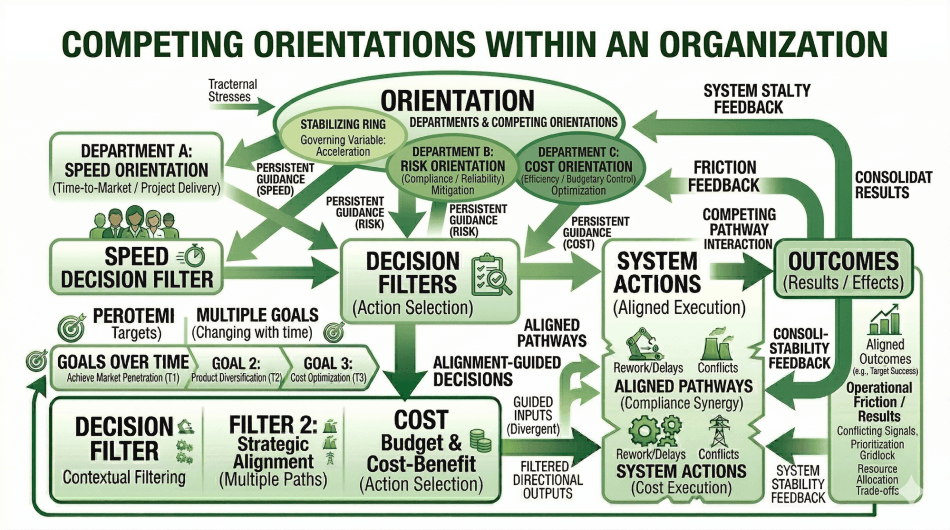
In Systems Language, competing orientations occur when different parts of a system stabilize around different governing variables.
Orientation determines which signals a system prioritizes and which trade-offs it is willing to make. When the governing variable differs across subsystems, each subsystem interprets situations through a different decision filter.

System alignment occurs only when those local decisions reference a shared governing orientation.
Within the five-pillar framework, Orientation provides the central reference that prevents departments from stabilizing around competing directions.