

Systems rarely lose direction all at once.
More often, the change is gradual. At first, the differences are small. A few decisions feel slightly inconsistent. Teams begin interpreting priorities differently in certain situations. Projects that once moved smoothly start requiring more clarification.
Nothing appears dramatically wrong.
But over time, these small deviations accumulate. Decisions become harder to coordinate. Outcomes feel less predictable. The system begins to feel like it is working harder while producing less coherent results.
These are often the early signals of orientation drift.
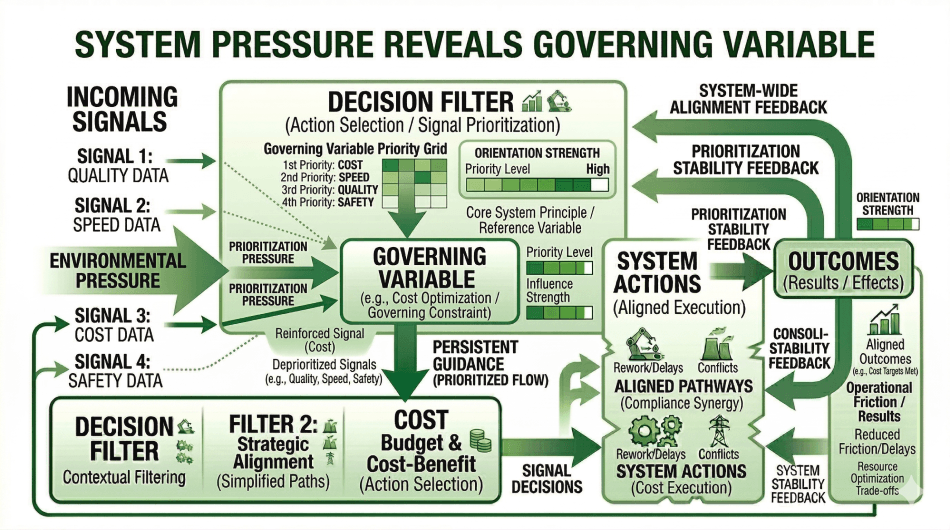
Systems Layer
In Systems Language, orientation drift occurs when the governing variable that stabilizes a system begins to weaken or fragment.
A system maintains alignment when its governing variable consistently filters incoming signals and resolves trade-offs. This creates stable decision patterns across different parts of the system.

They drift gradually as the governing variable loses its influence over decisions.
Within the five-pillar framework, Orientation must be periodically revalidated to ensure the system continues stabilizing around the same governing direction.
