

Complex environments create difficult decisions.
Organizations face competing priorities: speed versus quality, growth versus stability, innovation versus reliability. Each option may appear valuable, and choosing between them can feel complicated.
To manage this complexity, teams often introduce more analysis, more meetings, and more approval layers. The intention is to make better decisions by considering more information.
Yet in many cases, the real challenge is not a lack of information.
It is a lack of clear direction.
When the system’s orientation is well defined, many decisions that once felt complex become much easier to resolve.
Systems Layer
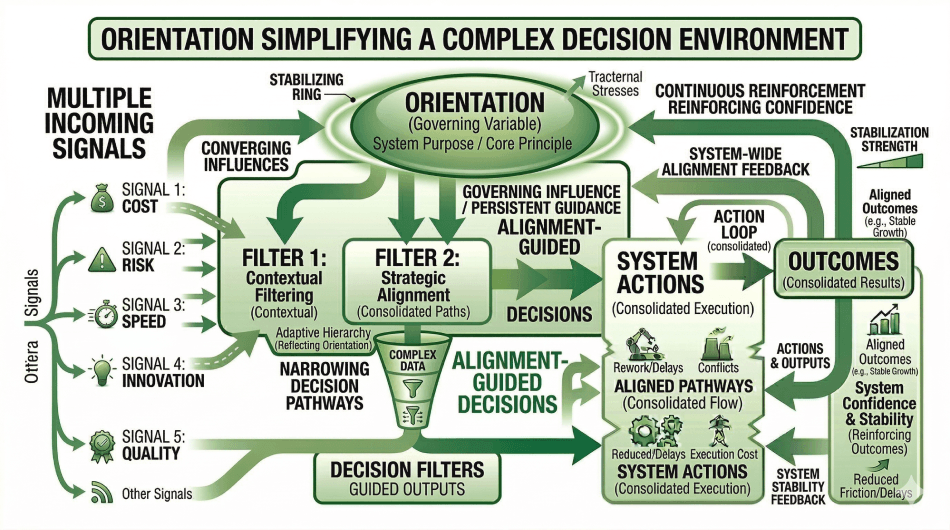
In Systems Language, orientation simplifies decision environments by acting as a dominant signal that organizes competing inputs.
Complex systems constantly receive signals from multiple sources: customer needs, operational constraints, financial pressures, regulatory requirements, and technological possibilities.

It comes from establishing a governing direction that organizes complexity.
Within the five-pillar framework, Orientation simplifies decision environments by filtering signals and aligning choices with a shared strategic direction.
