

Some organizations appear unusually consistent.
Decisions made by different teams tend to point in the same direction. New employees quickly learn “how things are done.” Even when leadership changes or processes evolve, the system’s behavior remains surprisingly stable.
What is interesting is that this consistency often exists without a clearly written rule explaining it.
People inside the system may struggle to articulate the principle guiding their decisions. Yet they instinctively know when something feels “off direction.”
This is often the result of an invisible center.
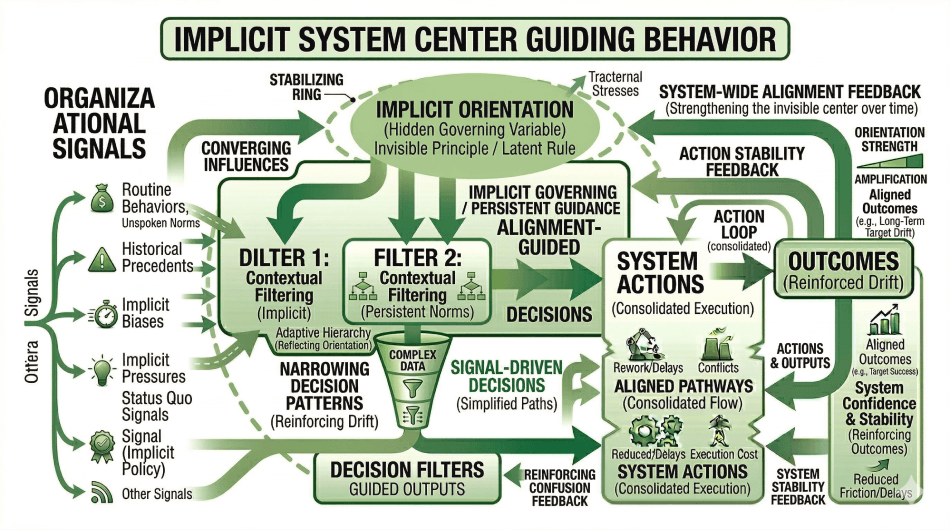
Systems Layer
In Systems Language, strong systems often stabilize around an implicit governing variable that functions as the system’s center of orientation.
This governing variable may not be formally documented or explicitly communicated. Instead, it emerges through repeated interactions between decision filters, incentives, leadership signals, and feedback loops.

Within the five-pillar framework, Orientation becomes most powerful when it is not only stated but embedded deeply enough in system behavior that it continues guiding decisions even when no one explicitly references it.
