

Many teams feel overwhelmed by the number of decisions they must make.
Every day brings new requests, opportunities, trade-offs, and problems. Should the team pursue this idea? Adjust this process? Respond to this signal? Evaluate this opportunity?
Without a clear way to prioritize, each situation becomes a separate discussion. Meetings expand, analysis grows, and decision fatigue begins to accumulate.
The challenge is often not the number of signals entering the system.
It is the absence of a filter that quickly determines which signals deserve attention.
Systems Layer
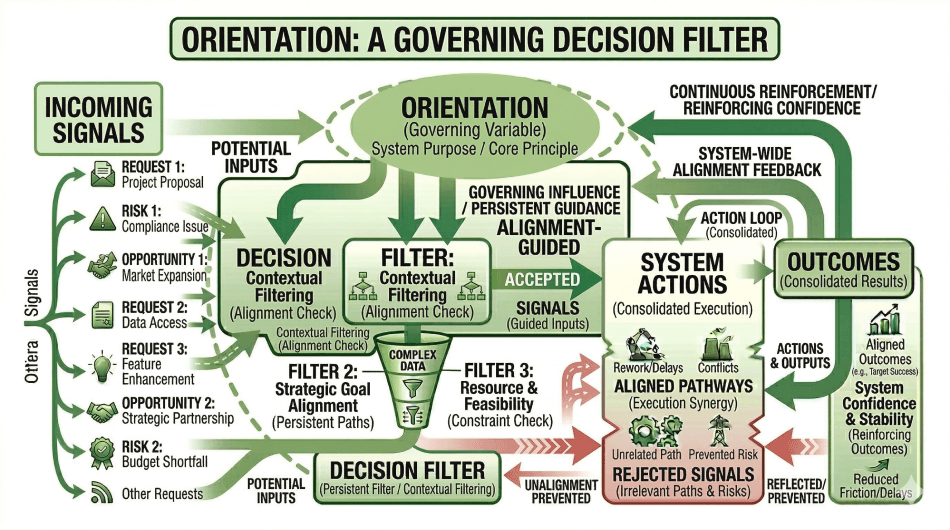
In Systems Language, orientation functions as a decision filter that reduces the cognitive load of the system.
Systems constantly receive signals from their environment: opportunities, risks, requests, and constraints. Each signal has the potential to trigger evaluation and action.

They eliminate unnecessary ones.
Within the five-pillar framework, Orientation reduces cognitive load by filtering signals before they enter the decision process, allowing the system to focus its attention on choices that reinforce its direction.
