
Growth is usually treated as a sign that a system is working.
Customers increase, teams expand, new products are introduced, and operations become more sophisticated. From the outside, expansion looks like success.
But inside the system, growth often introduces a quieter problem.
As complexity increases, decisions become harder to coordinate. Different teams interpret priorities differently. New initiatives appear that do not clearly connect to the system’s original purpose.
The system continues growing – but its direction becomes less clear.
This is one way growth can break orientation.
Systems Layer
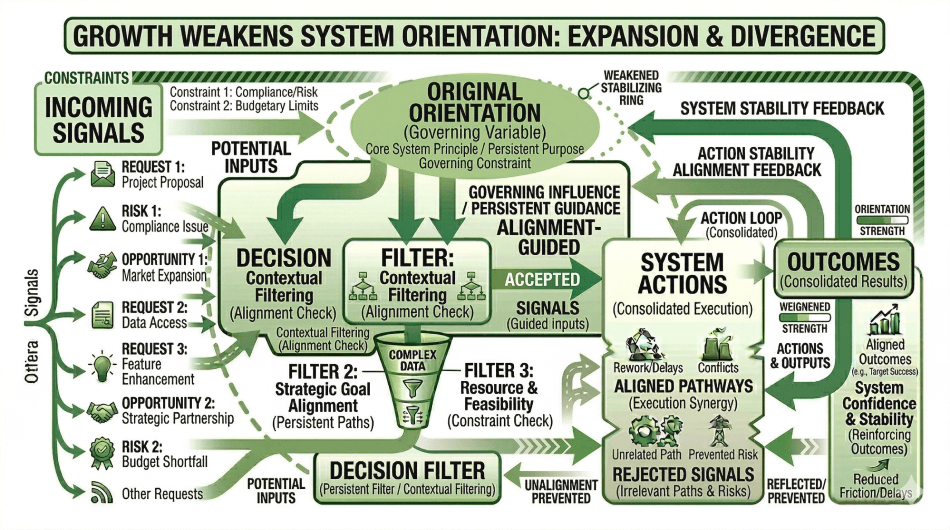
In Systems Language, expanding systems experience structural complexity growth, which increases the number of signals, decision points, and interacting subsystems within the environment.
When a system is small, orientation naturally stabilizes behavior because the number of interactions is limited. Decision pathways are short, and participants share a common understanding of priorities.

Complexity increases the distance between decisions and direction.
Within the five-pillar framework, Orientation must be continuously reinforced as systems expand, or growth will gradually replace shared direction with competing local priorities.