
Many people feel busy but not necessarily directed.
Tasks accumulate throughout the day – emails, meetings, requests, ideas, opportunities. Each item may seem important in isolation, yet by the end of the week it can be difficult to explain what progress was actually made.
The problem is often framed as a productivity issue. People look for better tools, improved time management techniques, or more efficient workflows.
But the deeper issue may not be efficiency.
It may be that the personal system lacks a clear orientation.
Systems Layer
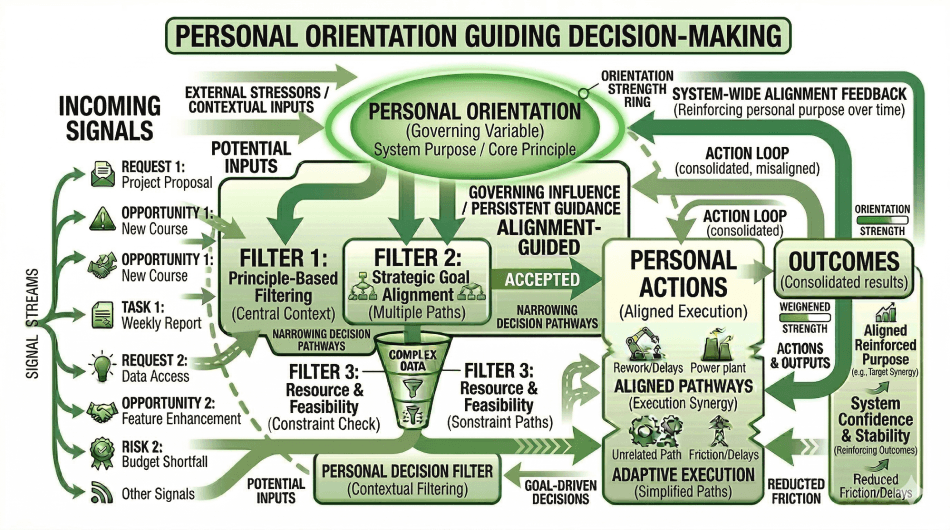
In Systems Language, individuals operate as decision systems that continuously process signals from their environment.
These signals include responsibilities, opportunities, obligations, requests from others, and internal motivations. Each signal competes for attention and action.

Within the five-pillar framework, Orientation provides the directional anchor that allows individuals to filter signals, reduce cognitive load, and concentrate effort on actions that reinforce their intended direction.