

When a structure is strong, everything attached to it behaves predictably.
A building holds its shape because its internal frame distributes forces in a stable way. Even when wind pushes against the outside, the structure remains coherent because its internal supports keep everything aligned.
Systems behave in a similar way.
When direction is clear, teams, processes, and decisions reinforce each other. Work flows smoothly because each part of the system moves within the same structural logic.
But when that internal structure weakens, the system begins to feel unstable. Coordination becomes harder. Decisions feel inconsistent. Effort increases, yet alignment decreases.
Often the missing element is the system’s structural core.
Systems Layer
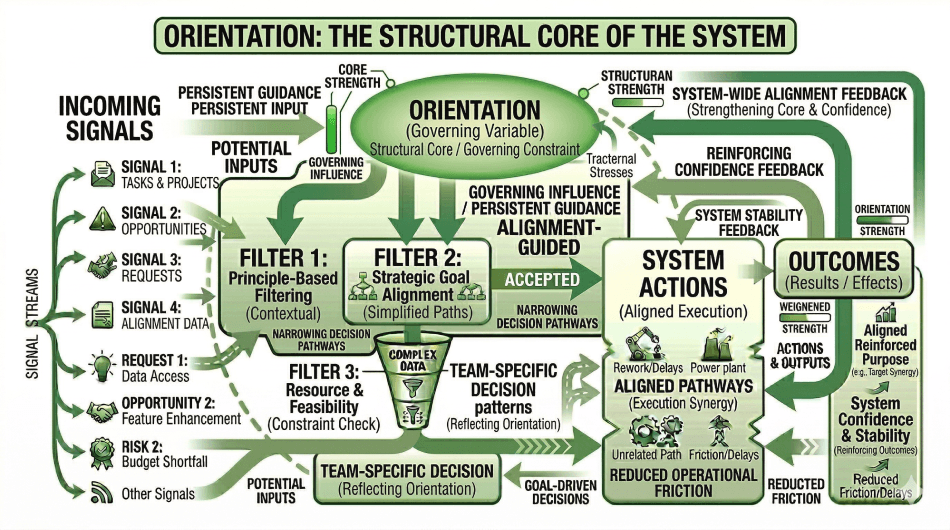
In Systems Language, orientation functions as the structural integrity of a system.
Orientation establishes the governing variable that organizes how the system interprets signals, resolves trade-offs, and produces decisions. This governing variable acts as a central structural constraint around which other components operate.

Within the five-pillar framework, Orientation functions as the structural core that holds the system together, allowing teams, processes, and tools to operate independently while remaining aligned with the same direction.
