

In many workplaces, the most capable people often become the most overloaded.
They understand complex systems quickly. They solve difficult problems. When something breaks, they are the ones others turn to for answers.
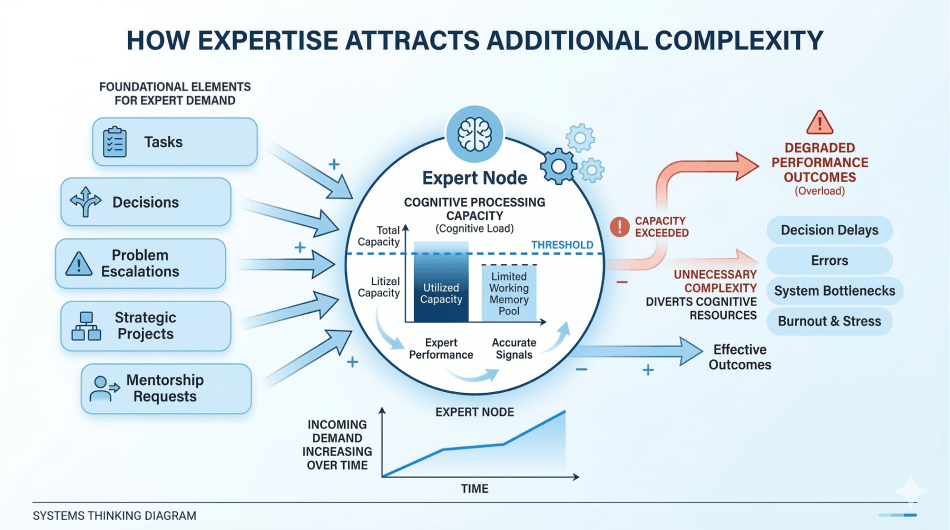
Over time, more decisions flow toward them. More projects require their input. More complexity passes through their desk.
Eventually, even the most capable professionals begin to feel the strain. Decisions slow down. Small details slip. The workload feels constantly full.
The problem isn’t a lack of intelligence.
It’s the structure of cognitive capacity.
Systems Layer
Cognitive systems operate under fixed processing constraints, regardless of individual expertise or intelligence.
While experience can improve efficiency through schema formation and pattern recognition, it does not remove the finite capacity of working memory — the system responsible for processing active information and decisions.

Within the Cognitive Load pillar, sustainable performance comes from distributing complexity across the system, rather than concentrating it within a few highly capable individuals.
Leverage appears when systems scale structure, not just talent.
