

A team begins working on a project together. At first, collaboration feels productive. Everyone shares updates, ideas, and questions through meetings, chat channels, and shared documents.
But as the project grows, the volume of communication increases. Messages multiply. More people become involved in each decision. Conversations overlap across multiple platforms.
Soon, team members feel like they are constantly catching up on information rather than making progress.
The work itself hasn’t necessarily become more complex.
What has changed is the structure of how information moves through the team.
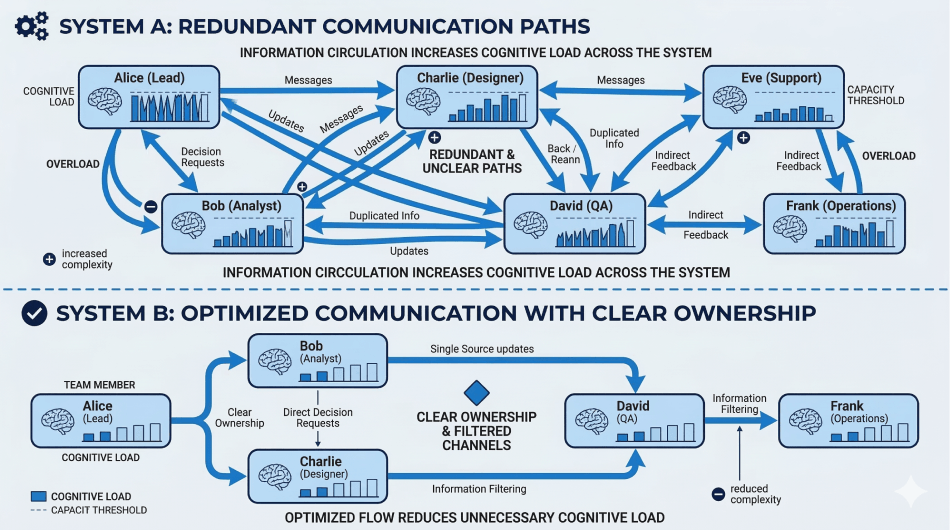
Systems Layer
In team environments, cognitive load does not exist only at the individual level. It also emerges from the structure of information flow across the group.
Each team member acts as a processing node within the larger system. Information enters these nodes through communication channels, task assignments, and decision requests.

Within the Cognitive Load pillar, effective teams reduce distributed overload by designing clear ownership, filtered information flows, and structured decision pathways.
When information moves through the right nodes rather than through every node, the system preserves cognitive capacity for meaningful work.
