
Throughout most of human history, information arrived slowly.
Messages traveled at the speed of conversation, letters, or physical movement. News spread gradually. Decisions often had time to develop before new information appeared.
Today, information moves very differently.
Messages arrive instantly. Dashboards update continuously. Notifications appear throughout the day across multiple devices. Data streams from countless sources compete for attention.
The modern environment produces more information in a single day than earlier systems encountered in weeks or months.
Yet the human cognitive system has not changed at the same pace.
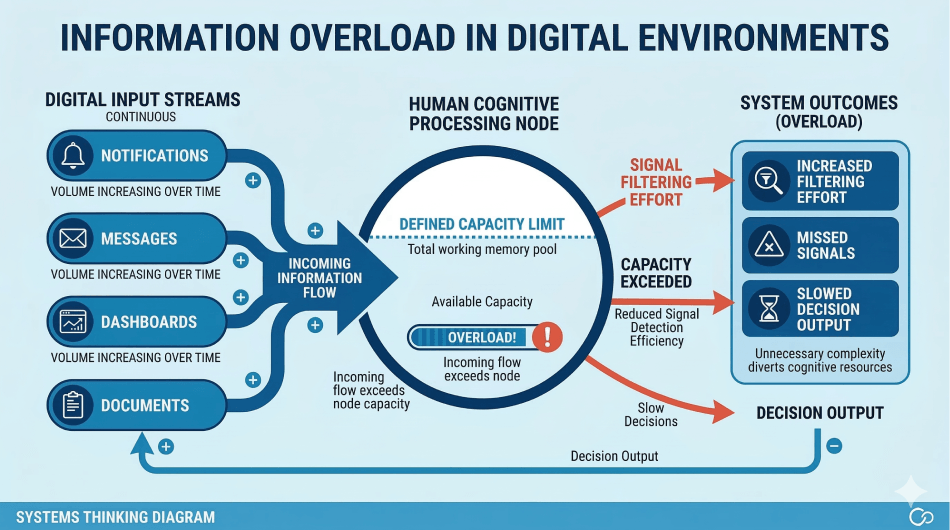
Systems Layer
Human cognition evolved within environments where information flow was limited, sequential, and relatively slow.
Under these conditions, cognitive systems could process incoming signals, form interpretations, and generate decisions without sustained saturation.

Within the Cognitive Load pillar, the critical leverage point is designing environments where information is filtered, structured, and paced so that cognitive systems can process signals without becoming overwhelmed.
Clarity depends not on how much information exists, but on how much arrives at once.