
In many environments, people assume that progress is mainly about removing obstacles.
If a team could move faster, if decisions could be made more freely, if resources were unlimited, then performance would improve.
Constraints are often seen as barriers — things that slow work down or prevent systems from reaching their potential.
Yet when constraints disappear entirely, systems can become unstable.
Without limits, growth may accelerate uncontrollably, decisions may conflict, and resources may be used inefficiently. In many cases, constraints are not simply restrictions.
They are part of what allows a system to function in a stable and predictable way.
Systems Layer
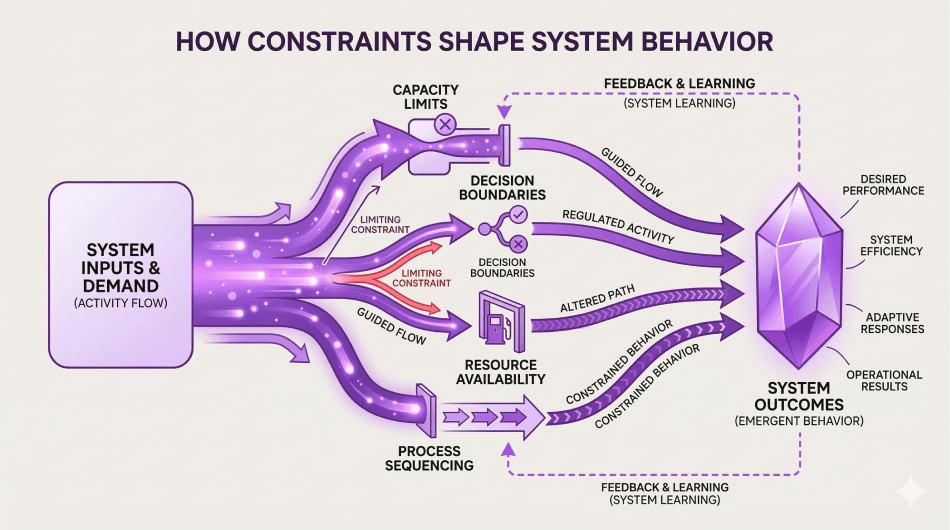
A constraint is a structural limit that shapes what actions are possible within a system.
Constraints influence system behavior by defining:

Understanding how constraints guide activity allows systems to be designed with the right balance between flexibility and stability.
Pillar: Systems Language — perception.