
In many organizations, tasks appear to belong to separate teams.
One group handles planning. Another manages operations. A third oversees reporting or compliance.
At first glance, each part seems to operate independently.
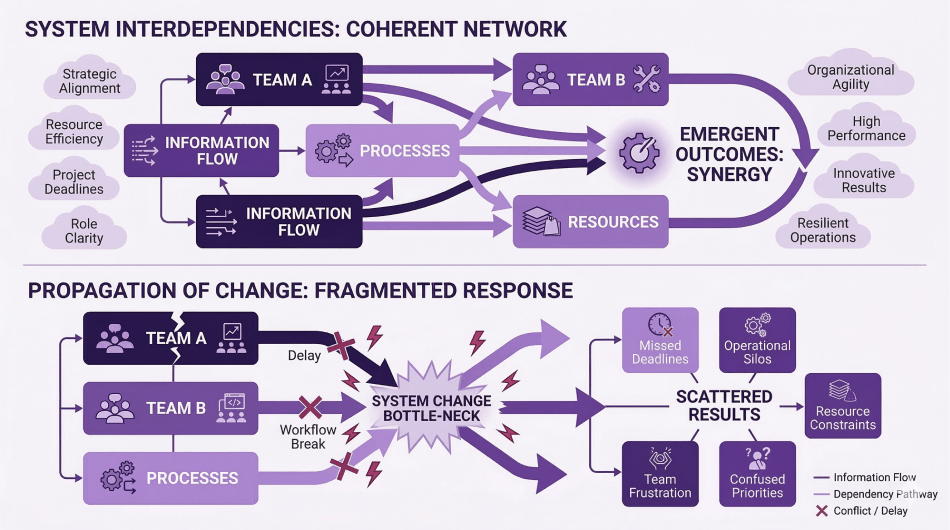
But when something changes in one area, unexpected effects often appear elsewhere. A shift in priorities alters workload distribution. A delay in one process slows several others. A new policy influences how multiple teams coordinate their work.
These outcomes occur because systems are not made of isolated parts.
They are made of interdependencies.
Systems Layer
An interdependency exists when the behavior or performance of one system component depends on the actions or outputs of another.
In complex systems, components rarely operate in isolation. Instead, they form networks of relationships involving:

Understanding interdependencies is essential for managing complex environments.
Pillar: Systems Language — perception.