
Decisions in complex environments rarely produce simple outcomes.
A change intended to improve efficiency may create new bottlenecks elsewhere. A policy designed to solve one problem may introduce unexpected side effects. A strategic initiative may succeed initially but later encounter limits that were not anticipated.
These situations are not usually caused by poor intentions.
They occur because decisions interact with systems that contain many interconnected parts.
Without understanding those structures, decision-makers are often responding only to the visible surface of the system.
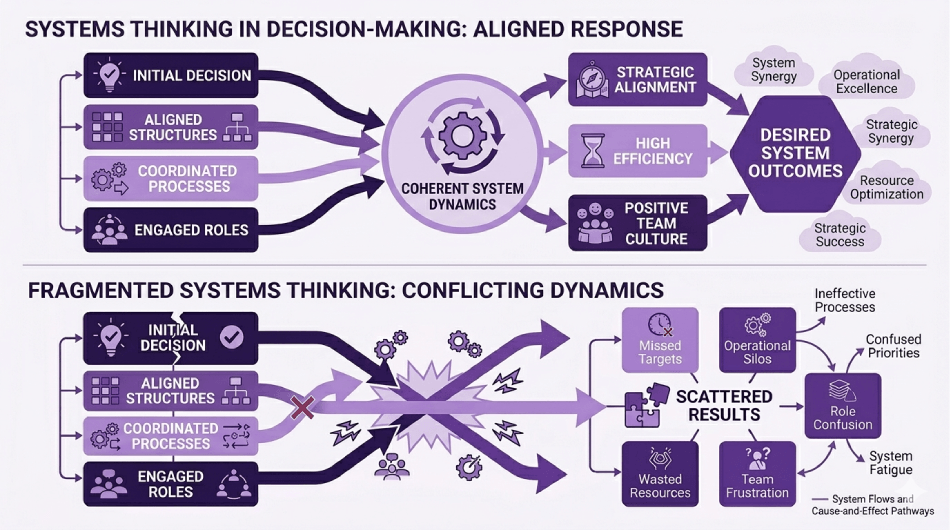
Systems Layer
Systems thinking in decision-making involves examining the structural conditions that shape how a decision will influence the broader system.
Rather than evaluating a decision in isolation, this approach considers how the decision interacts with:

Systems Language provides a framework for examining structures, interactions, and feedback dynamics — allowing decisions to be evaluated within the full context of the system.
Pillar: Systems Language — perception.