
Leadership decisions often appear to focus on people.
A leader motivates the team, sets priorities, resolves conflicts, and guides strategy. Many leadership discussions therefore emphasize communication style, personality, or individual influence.
These qualities matter. But leaders frequently encounter situations where effort and communication alone do not solve the problem.
Teams remain overloaded despite working harder. Coordination issues persist even after repeated meetings. Initiatives stall even when everyone agrees on the goal.
In these moments, the issue is rarely motivation.
The issue is often structure.
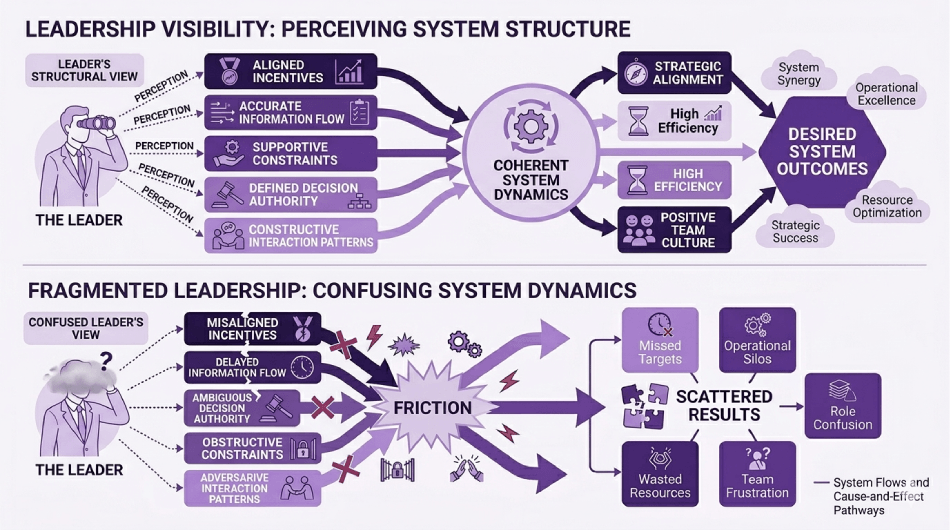
Systems Layer
Structural clarity is the ability to perceive and understand the underlying system dynamics shaping outcomes.
Leaders with structural clarity examine systems in terms of:

Structural clarity allows leaders to see the arrangements, constraints, and interactions shaping behavior — making it possible to guide outcomes by adjusting the system itself.
Pillar: Systems Language — perception.