
Outsourcing is often introduced with a simple expectation: if someone else is doing the work, the internal team should have less to manage.
But in many cases, the opposite occurs.
Instead of performing the tasks themselves, internal teams now spend their time reviewing outputs, answering questions, clarifying instructions, and coordinating with external contributors. The work may be happening elsewhere, but the mental effort required to manage it seems to increase.
The system has distributed the tasks—but it may have concentrated the supervision.
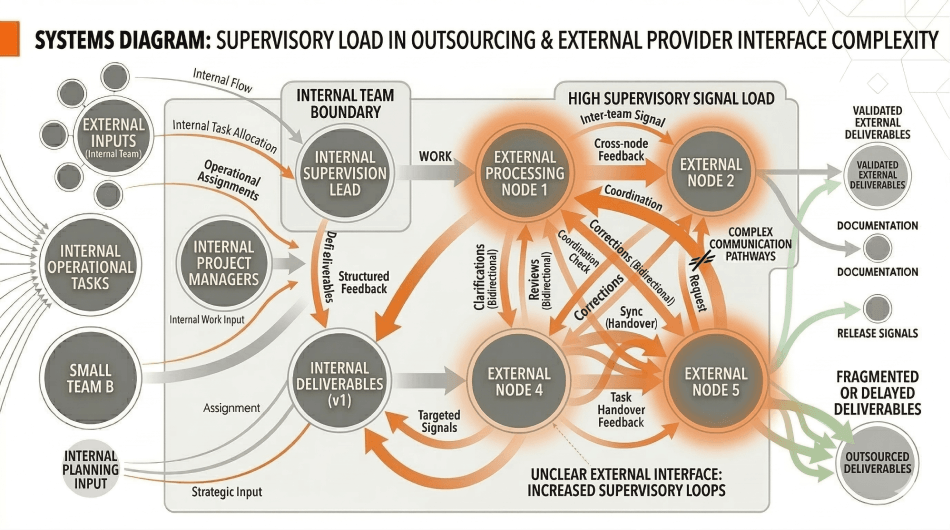
Systems Layer
Outsourcing introduces additional processing nodes outside the original system boundary.
While these nodes absorb operational load, they also require coordination signals to function correctly. Work must be defined, instructions transmitted, outputs evaluated, and adjustments communicated.

It is to design a system where external nodes can process work with minimal ongoing intervention from the internal system.
When the structure is clear, supervision becomes occasional guidance rather than constant cognitive effort.