
When work is distributed across multiple roles or teams, leaders often face a familiar tension.
If they monitor everything closely, the system begins to feel slow and constrained. Every step waits for approval, and contributors hesitate to act without confirmation.
But if oversight disappears entirely, the system can drift. Decisions are made independently, sometimes moving in directions that do not align with broader priorities.
The challenge is not choosing between control and autonomy. The challenge is balancing them within the system’s structure.
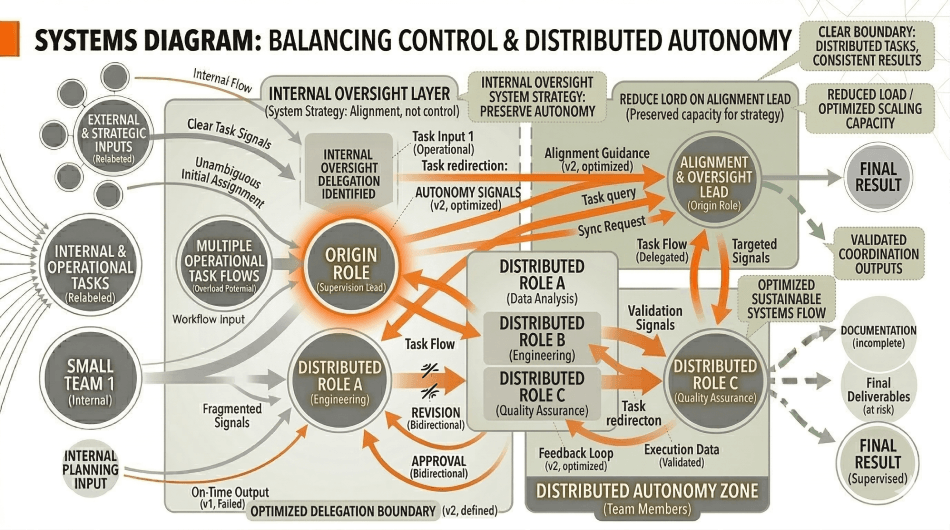
Systems Layer
Distributed systems operate through multiple processing nodes working semi-independently.
For the system to function effectively, each node must have enough autonomy to process tasks without constant supervision. This autonomy allows the system to scale its processing capacity and respond quickly to local signals.

Autonomy allows nodes to process work efficiently, while oversight ensures that distributed activity remains aligned with the system’s direction.
Together, these forces create distributed systems that are both scalable and coordinated.