
Employee empowerment is often described in terms of trust, autonomy, or motivation. These descriptions are accurate but incomplete. Empowerment becomes durable only when it is supported by structural mechanisms that allow employees to act on their judgment without repeatedly encountering capacity limits.
One observable moment makes this clear. An employee recognizes what needs to be done but cannot proceed because the required time, skill, or tool is unavailable internally. The insight exists, but the system does not allow it to be acted upon. Over time, this gap erodes initiative more effectively than any lack of encouragement.
Outsourcing changes this condition by redistributing access to resources.
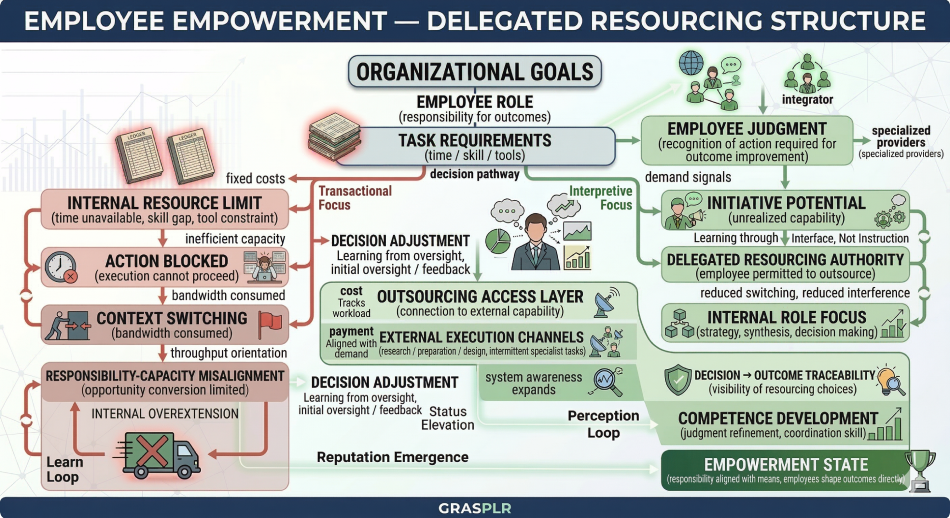
Empowerment as Responsibility with Means
Giving employees the ability to outsource is not simply giving permission. It is assigning responsibility together with the means to fulfill it.
The car-key analogy works when interpreted structurally. Handing over the keys signals that the driver is trusted not just to move, but to navigate within rules, constraints, and shared objectives. The driver does not choose the destination alone, but they control how to get there.

When employees can access external capability within clear boundaries, they stop working around constraints and start shaping outcomes. Productivity and innovation follow not because people are inspired, but because the system no longer blocks effective action.
Empowerment, in this form, is quiet, practical, and resilient.