

“How to empower employees” is often interpreted as a question of management technique. In practice, empowerment emerges less from what leaders say and more from how roles are constructed and constrained.
Outsourcing becomes relevant at the moment when employees are capable of higher-level contribution but remain occupied by work that fragments their attention. The observable signal is not low performance, but congestion: skilled people spending time on tasks that dilute judgment rather than sharpen it.
Empowerment, in this context, is not about removing oversight. It is about redesigning boundaries so that employees can operate where their contribution has the most leverage.
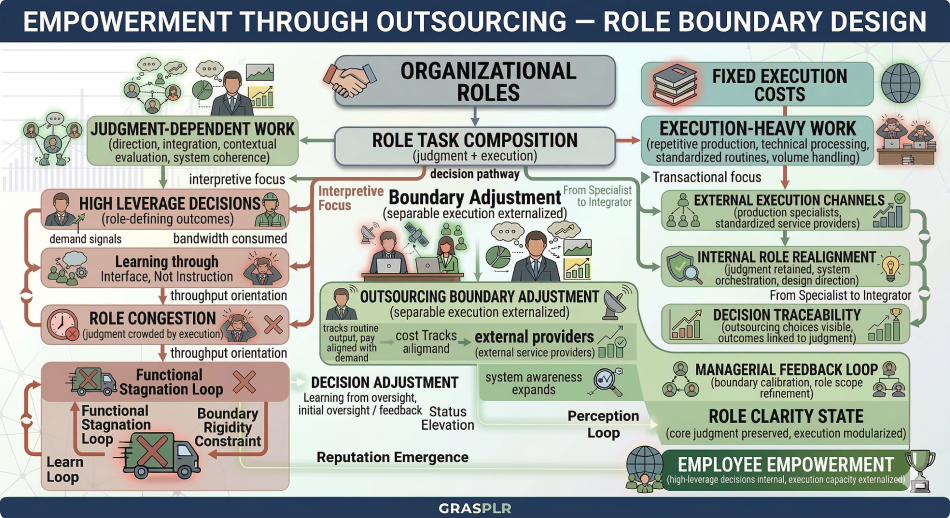
Outsourcing as Boundary Adjustment
When employees are allowed to outsource certain categories of work, the boundary of their role shifts. Execution-heavy or highly repeatable tasks move outward. What remains inside the role is work that depends on context, taste, sequencing, or integration.

Employees feel empowered when they can shape outcomes without constantly compensating for missing capacity. Outsourcing provides one mechanism for closing that gap, provided it is designed around judgment rather than volume.
When this alignment holds, productivity and innovation tend to rise quietly—not because people are told to do more, but because the system finally lets them do what they are already capable of.
