
Innovation is often attributed to mindset, culture, or individual creativity. These factors matter, but they tend to obscure a more reliable driver: how permeable an organization’s boundaries are to new information, methods, and constraints.
A useful starting image is growth under controlled conditions. A seed does not innovate on its own. What matters is whether the surrounding environment allows variation, exposure, and feedback. Too closed, and growth stagnates. Too open, and structure collapses. Innovation appears in the middle ground.
Outsourcing changes this middle ground by selectively opening boundaries.
Organizations typically rely on stable internal routines. These routines are efficient, but they also filter out novelty. Over time, teams become well-adapted to yesterday’s problems. When markets, technologies, or customer expectations shift, this adaptation turns into inertia.
Outsourcing interrupts this pattern.
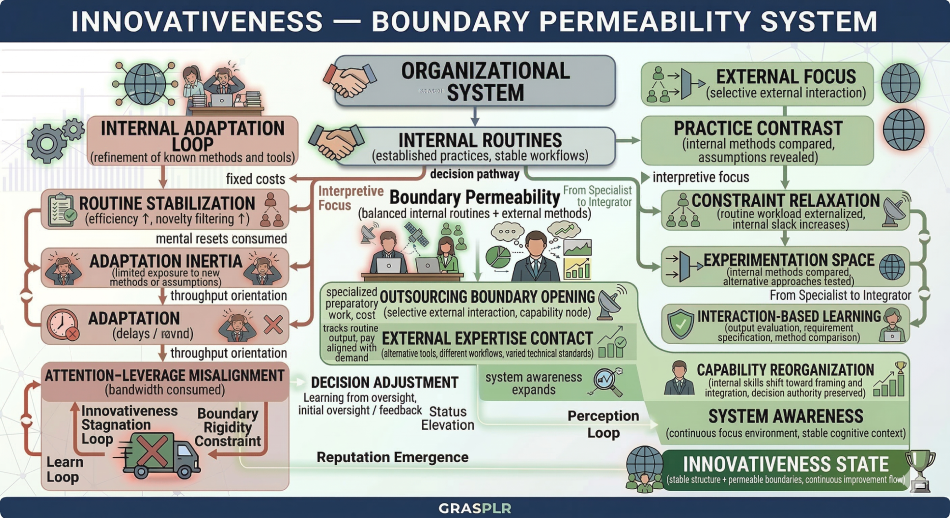
Novelty Through Contact, Not Disruption
When work is entirely internal, learning is endogenous. Teams refine what they already know. Outsourcing introduces exogenous input: different tools, practices, assumptions, and standards.

The seed metaphor holds if treated carefully: growth depends less on exhortation and more on conditions. When boundaries allow the right exchanges to occur, innovation follows as a natural consequence.