
Every system has a current state: a living snapshot of its pressures, patterns, constraints, and momentum.
Ignore that state, and even smart interventions can misfire.
System State is the practice of reading where a system actually is before deciding what it needs next. It turns strategy from assumption into diagnosis. Instead of guessing whether to accelerate, simplify, pause, or redesign, you examine whether the system is stable, strained, gaining speed, or quietly breaking beneath the surface.
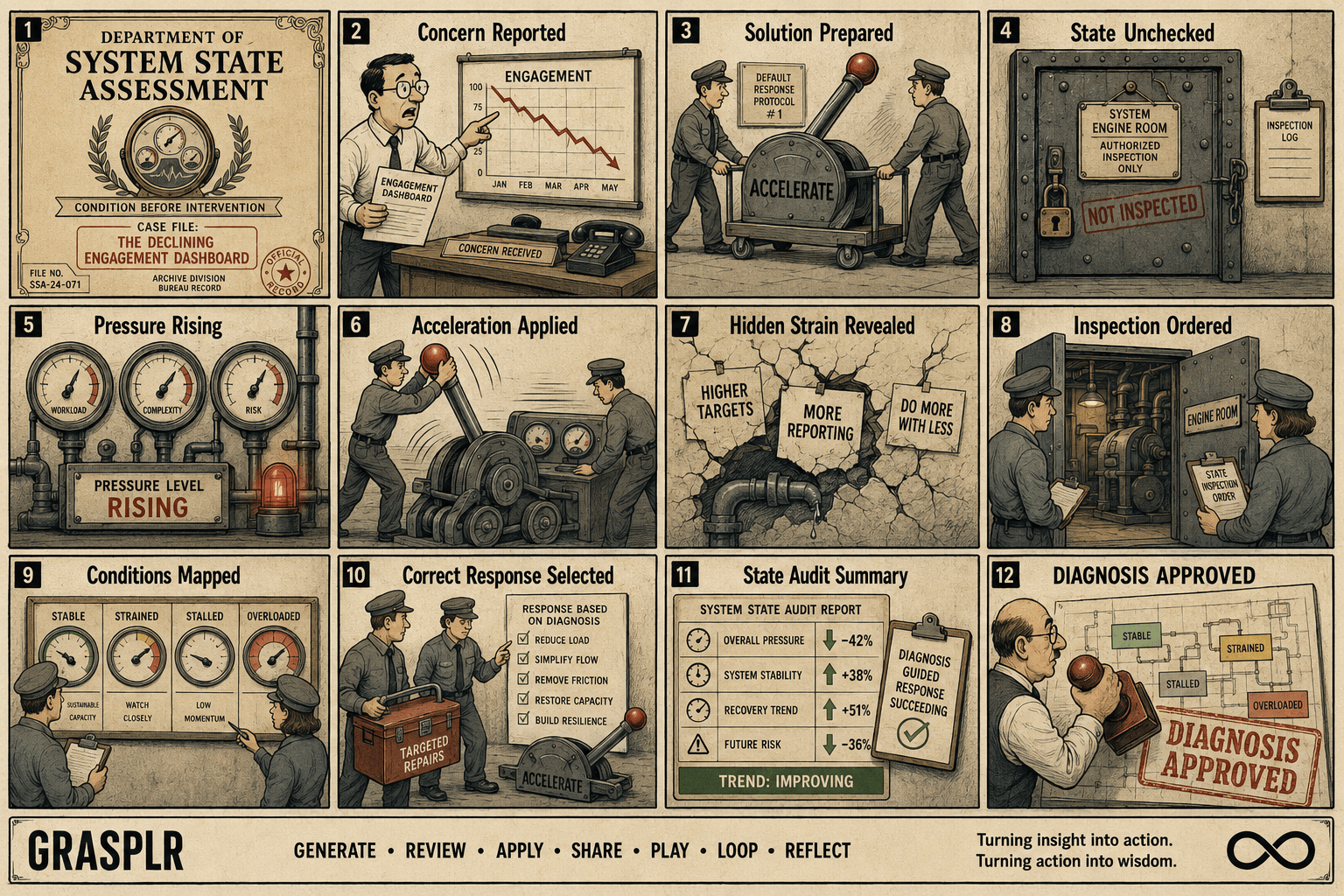
Change Fails When Context Is Misread
Most teams rush toward solutions before understanding the environment those solutions will enter.
They see declining engagement and add more content. They see slow execution and demand faster output. They see inconsistency and impose tighter structure.
But the same intervention can help one system and harm another. It depends on the system’s current state.
A tired system needs recovery. A chaotic system needs simplification. A mature system may need renewal. Without diagnosis, teams treat visible symptoms while intensifying the cause.
System State and Strategic Diagnosis
System State is the visible and hidden condition of a system at a specific moment.
It includes capacity, alignment, energy, friction, attention, incentives, and feedback quality. Together, these signals show what the system can absorb and what it will resist.
A content ecosystem with strong ideas but weak cadence may need rhythm. A team with high output but low coherence may need structure. An audience with declining response may not need louder messaging. It may need clearer value.
System State helps you choose interventions that match reality instead of preference.
Reading the Signals Before Acting
Start by identifying the system’s current signals.
- Capacity signals: Is the system underloaded, balanced, or overloaded?
- Friction signals: Where does progress slow, stall, or repeat?
- Alignment signals: Are people, messages, and incentives pulling in the same direction?
- Momentum signals: Is the system building energy, maintaining pace, or losing force?
- Feedback signals: Are you receiving clear information, distorted information, or silence?
Reading System State prevents you from mistaking movement for readiness. A system can look active while lacking the capacity, clarity, or alignment to absorb more change.
Diagnose First, Intervene Second
Strong systems are not improved by applying more force. They improve when the right force is applied at the right time.
System State gives you the situational awareness to decide whether to accelerate, pause, simplify, reinforce, or redesign.
When you understand the system’s current condition, strategy becomes less reactive and more precise. You stop asking only, “What should we do?” and start asking, “What is this system ready for next?”