
There is a moment when the system comes into view.
The same problem stops looking random. The same tension stops feeling personal. The same delay stops appearing isolated.
What once looked like disconnected events begins to reveal a deeper structure.
When the System Becomes Visible means crossing from reaction into recognition. You begin seeing the patterns, pressures, feedback loops, constraints, and relationships that were shaping outcomes all along.
Surface Events Keep Attention Moving Too Fast
Most people live inside systems by reacting to what appears next.
A complaint needs answering. A deadline needs rescuing. A conflict needs calming. A mistake needs correcting.
Each event demands attention. Because the event is visible, it feels like the whole problem.
But surface events often move faster than understanding.
They pull attention from one urgent moment to another without giving the deeper pattern time to appear.
The result is constant response with limited learning.
People fix, explain, defend, adjust, and move on, only to meet the same issue again in a slightly different form.
The system stays hidden when attention never slows down long enough to notice what keeps repeating.
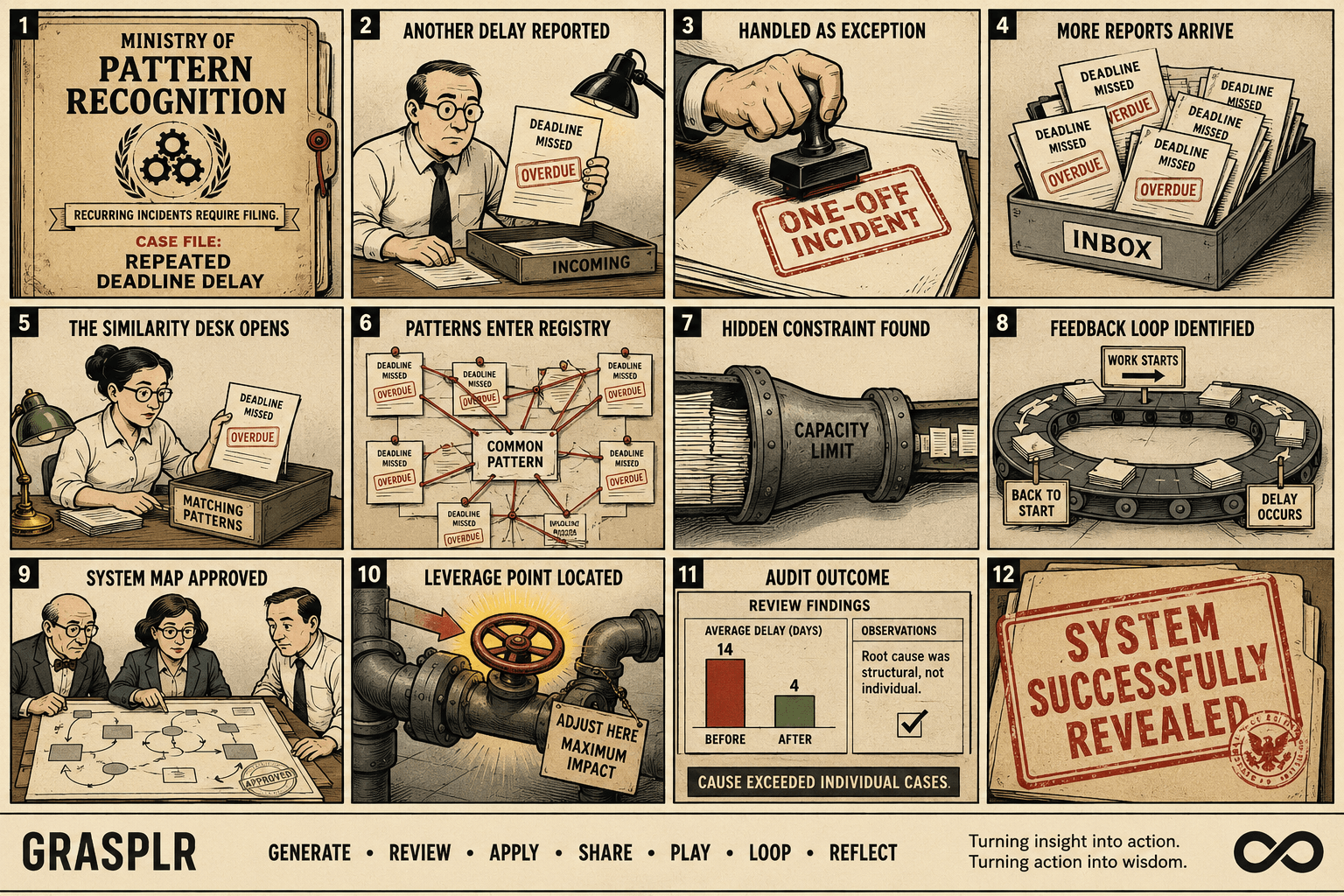
System Visibility as Pattern Recognition
System Visibility is the moment hidden structure becomes readable.
It happens when Systems Literacy turns scattered events into patterns, patterns into explanations, and explanations into redesign.
Slowing attention makes structure readable because it lets you compare events instead of treating each one as separate. Once you can see what repeats, where pressure gathers, how feedback returns, and which relationships keep producing the same outcome, the system begins to show its shape.
Think of it as the system stepping out from behind the event.
The missed deadline is no longer only a missed deadline. It may reveal capacity strain, unclear ownership, weak sequencing, or distorted incentives.
The recurring conflict is no longer only a personality issue. It may reveal misaligned expectations, unresolved pressure, or a relationship pattern that keeps reinforcing itself.
This shifts the question from “What happened this time?”
You begin asking, “What structure keeps making this happen?”
Seeing What Was Already Shaping the Outcome
To make a system visible, look beneath the event and across the pattern.
Visibility grows when repeated signals are connected.
Pattern traces: Identify what keeps returning across time, people, projects, or decisions. Repetition is often the first doorway into system visibility.
Pressure fields: Notice where urgency, demand, conflict, scarcity, or uncertainty keeps gathering. Pressure reveals where the system is carrying more than it can hold.
Feedback signals: Listen to complaints, delays, errors, questions, disengagement, and emotional friction. Feedback shows how the system is responding to its own design.
Constraint lines: Map the limits shaping behavior: time, tools, capacity, authority, knowledge, access, and rules. Constraints show why some actions feel possible and others do not.
Relationship links: Study how people, processes, beliefs, habits, and decisions influence one another. Systems become visible through connection, not isolation.
Once these signals are connected, the system stops feeling like a blur.
You can explain what is happening with more precision and redesign with less guesswork.
What Becomes Visible Can Become Changeable
Systems Literacy does not create the system.
It reveals the system that was already operating.
When the System Becomes Visible teaches that hidden patterns must become clear enough to understand before they can be changed with care.
When you see the structure, you stop wasting energy on surface reactions alone.
You can name the pattern, explain the pressure, trace the feedback, locate the constraint, and redesign the relationship between parts.
The system becomes changeable when it becomes visible.
Until then, people react to events.
After visibility, they begin to work with architecture.