
Organizations often become very good at improving performance.
Metrics are tracked carefully. Processes are optimized. Teams work to increase efficiency, reduce cost, and accelerate delivery. Over time, the system becomes highly effective at producing measurable results.
But occasionally something strange happens.
Despite improving its metrics, the organization begins to drift away from the purpose it was originally designed to serve.
The system becomes extremely efficient – but no longer clearly connected to its original direction.
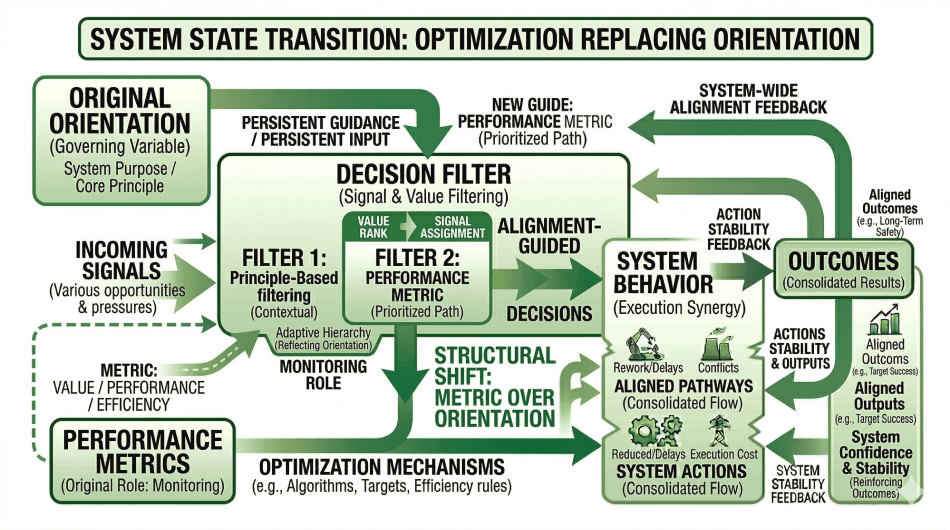
Systems Layer
In Systems Language, this occurs when optimization mechanisms replace orientation as the governing variable of the system.
Optimization systems operate by improving measurable indicators such as speed, output, cost reduction, or utilization. These indicators are useful because they allow performance to be monitored and improved through feedback loops.

They should not replace it.
Within the five-pillar framework, Orientation must remain the governing variable, while optimization systems operate as tools that improve performance without redefining the system’s direction.