
Complex situations often feel overwhelming.
Multiple teams are involved. Information arrives from many directions. Problems appear interconnected but difficult to explain. Decisions produce results that are hard to predict.
When complexity increases, it becomes difficult to see what is actually happening.
People may focus on isolated issues or attempt to manage each problem individually. Yet this approach rarely produces clarity.
Understanding complex environments often requires a different way of seeing the situation.
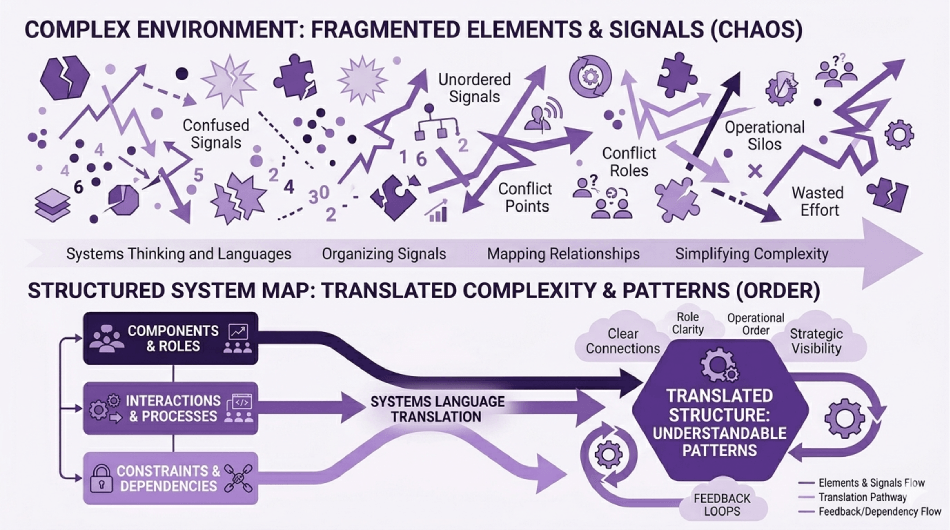
Systems Layer
Complex environments contain many interacting components, feedback loops, constraints, and dependencies.
Viewed directly, this network of interactions can appear chaotic.

Systems Language provides the tools to map interactions, constraints, and feedback relationships so that complex environments become understandable and navigable.
Pillar: Systems Language — perception.