

In many workplaces, complexity grows gradually.
A new tool is added to improve communication. Another process is introduced to increase accountability. A few more dashboards appear to provide better visibility.
Each addition seems reasonable on its own.
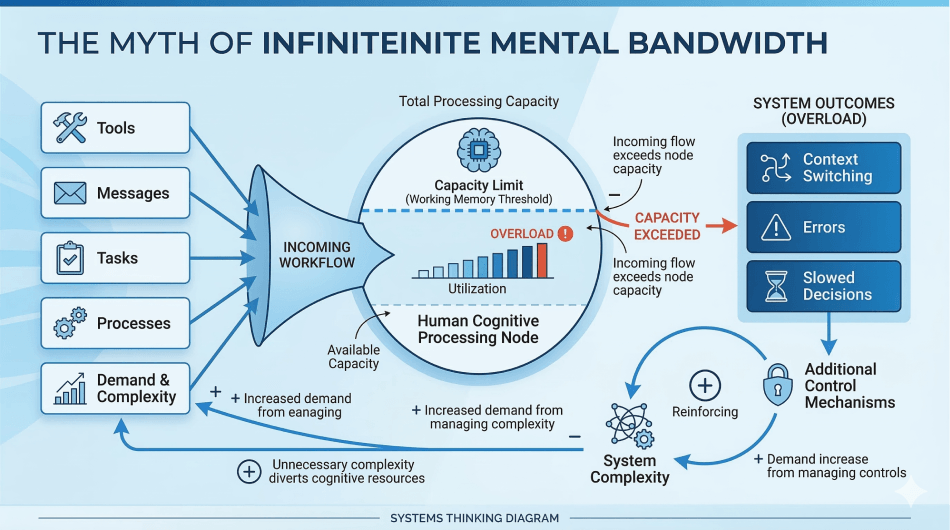
But over time, people begin to feel stretched. Messages accumulate. Context switching becomes constant. Tasks overlap in ways that are difficult to manage.
When this happens, the common response is simple: people just need to handle more.
The assumption is that human mental capacity can expand to match the system.
Systems Layer
Many modern work systems operate under an implicit assumption of infinite cognitive bandwidth — the belief that individuals can continuously absorb increasing complexity without structural limits.

Within the Cognitive Load pillar, performance improves not by expecting people to absorb more complexity, but by structuring systems that filter, sequence, and simplify information before it reaches human decision-makers.
Capacity is protected when systems manage complexity upstream.
